Lab

Experiments

Interactive classroom tools built at Riverside.
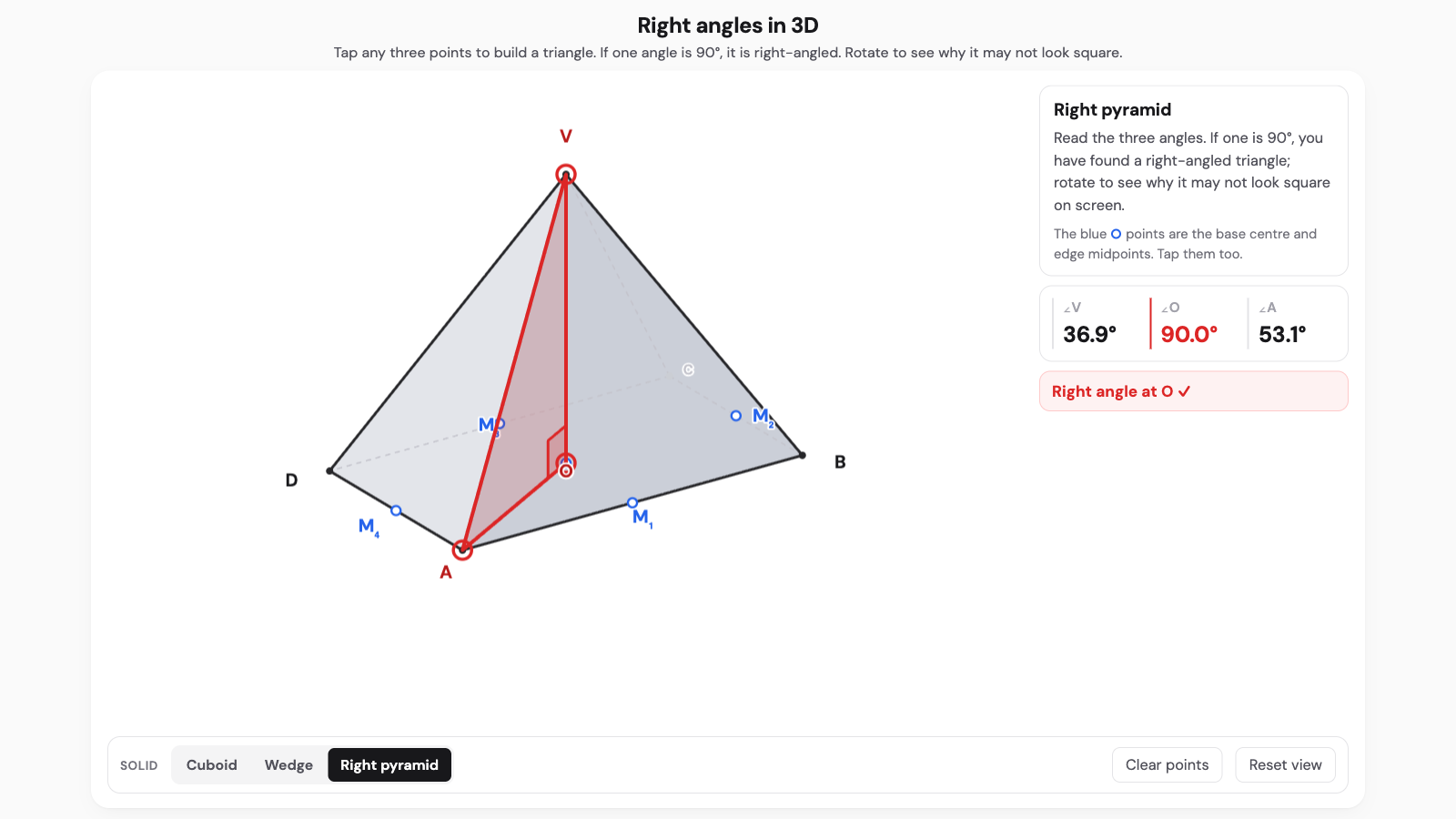
3D Right Angles interactive. Right-angled triangles inside cuboids, wedges and pyramids.

3D Right Angles

Sec 3 · E Math Ch 7 · Applications of Trigonometry

Rotate cuboids, wedges and pyramids to reveal the right-angled triangles hidden inside them.

Open interactive
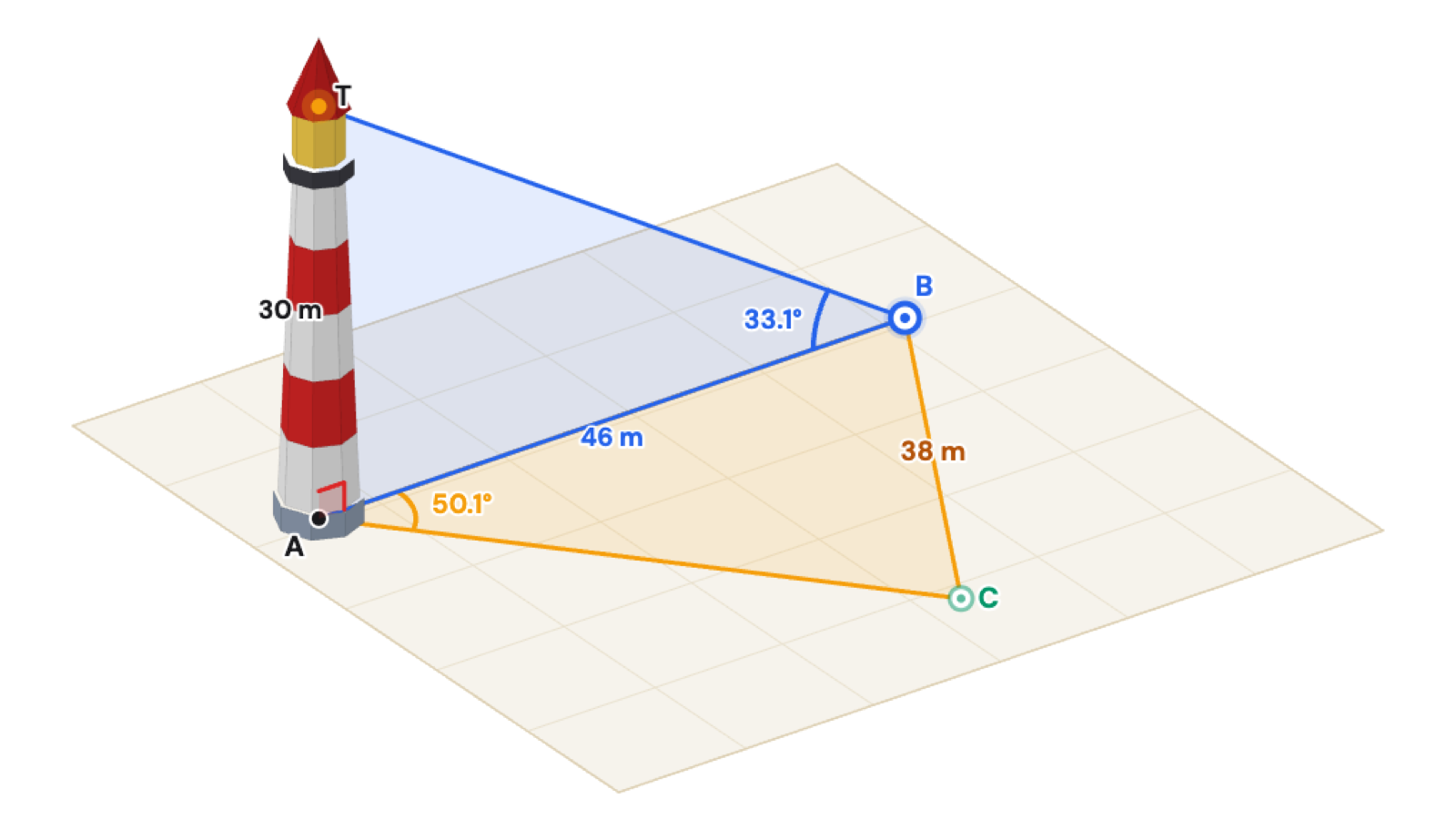
Angles of elevation and depression interactive. A lighthouse on a beach with lines of sight to two students, showing the angle of elevation equal to the angle of depression.

Elevation & Depression

Sec 3 · E Math Ch 7 · Applications of Trigonometry

Move students around a beach lighthouse and see the angle of elevation up to the light equal the angle of depression back down.

Open interactive
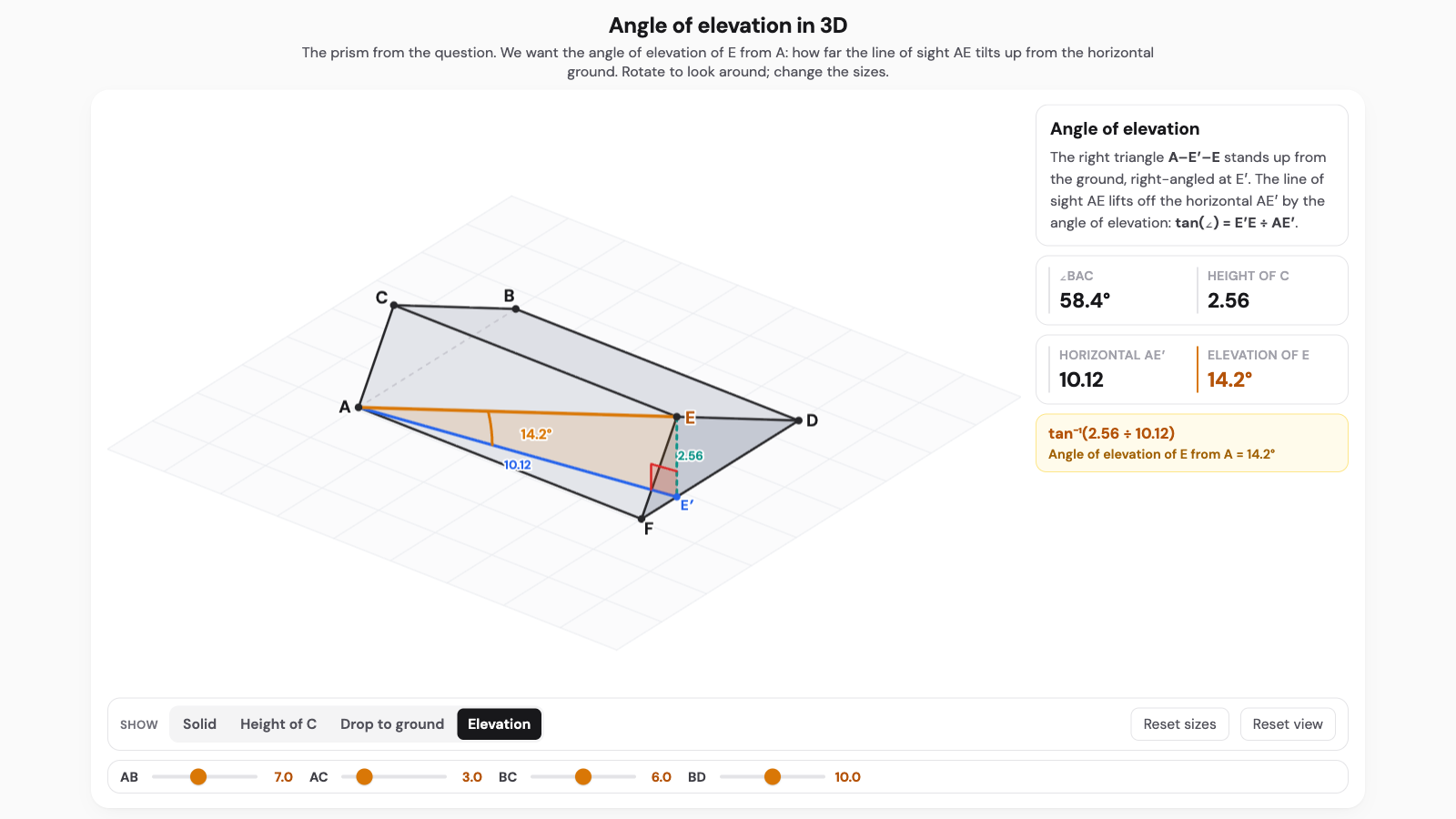
Angle of elevation in 3D interactive. A triangular prism on a horizontal grid, with the right triangle from corner A up to the far top corner E and the angle of elevation marked.

Angle of Elevation in 3D

Sec 3 · E Math Ch 7 · Applications of Trigonometry

Rotate the prism from the question and build the angle of elevation of E from A, one right triangle at a time.

Open interactive
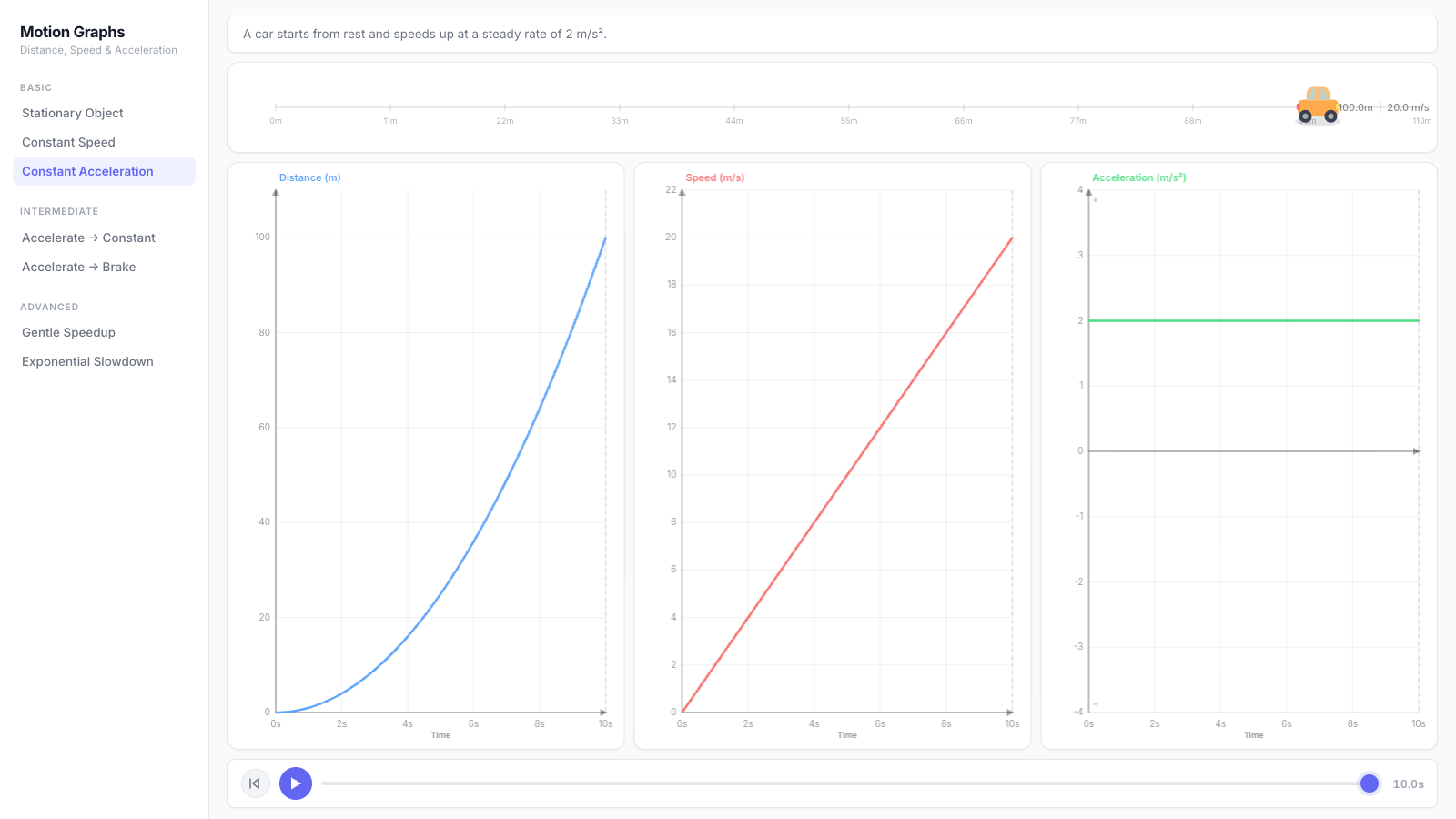
Motion Graphs interactive — distance, speed, and acceleration curves

Motion Graphs

Sec 3 · E Math Ch 5 · Graphs of Functions and Graphical Solution

Distance, speed, and acceleration visualised across live motion scenarios.

Open interactive
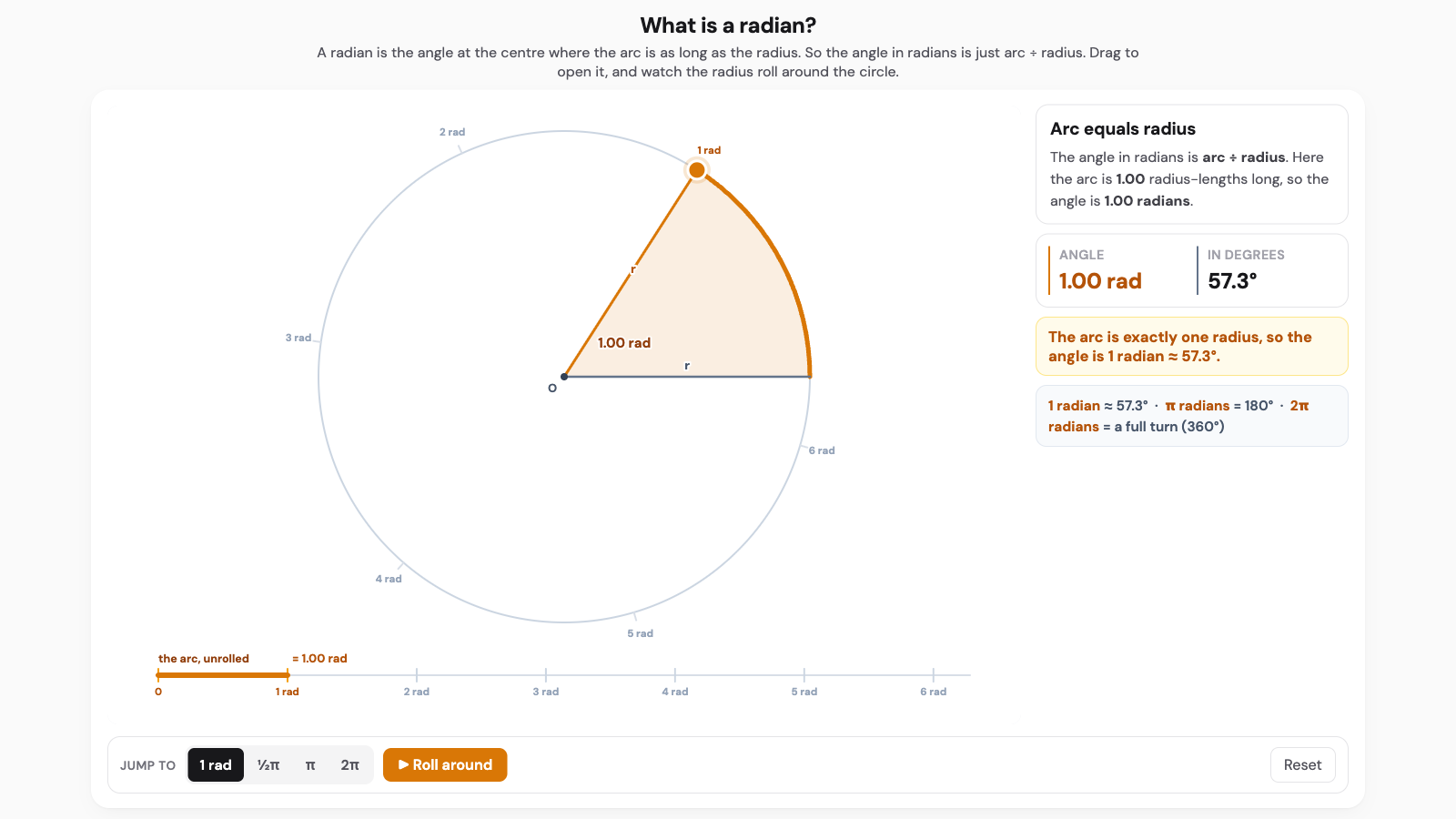
What is a radian interactive. A circle with an angle opened so the arc equals the radius, marked as one radian, and the radius rolling around the circumference.

What is a Radian?

Sec 3 · E Math Ch 8 · Arc Length, Sector Area and Radian Measure

Drag to open an angle: when the arc is as long as the radius, the angle is one radian. Roll the radius around and a whole turn comes to 2π.

Open interactive
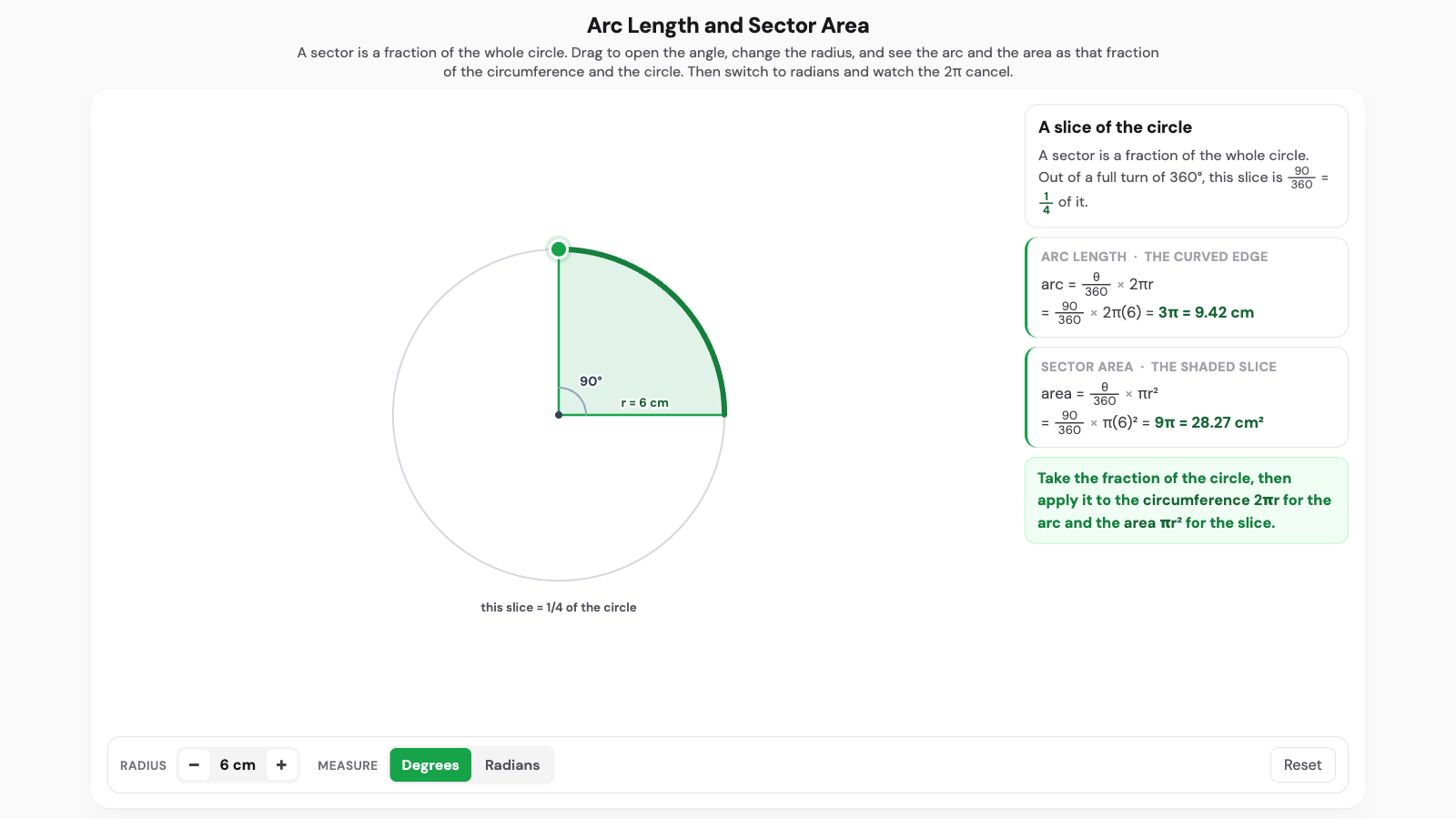
Arc length and sector area interactive. A quarter-slice of a circle shaded, with the arc length and sector area worked out as that fraction of the circumference and the circle's area.

Arc Length and Sector Area

Sec 3 · E Math Ch 8 · Arc Length, Sector Area and Radian Measure

A sector is a fraction of the whole circle. Drag the angle and see the arc and the area as that fraction of 2πr and πr², then switch to radians and watch the 2π cancel to rθ and ½r²θ.

Open interactive
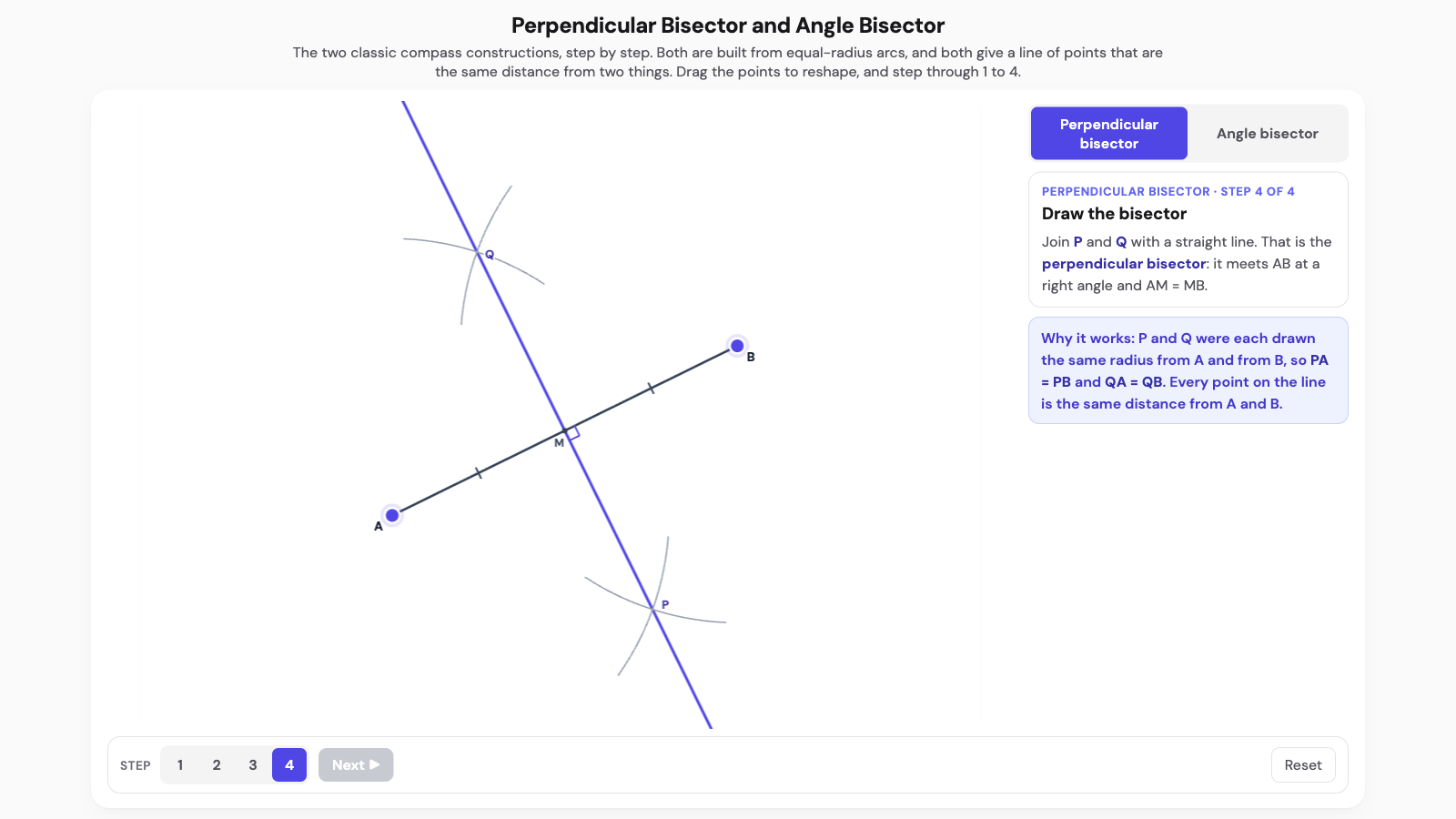
Bisector constructions interactive. A line segment AB with compass arcs crossing above and below, joined into the perpendicular bisector meeting AB at a right angle.

Perpendicular Bisector and Angle Bisector

Sec 3 · E Math Ch 9 · Congruence and Similarity Tests

The two compass constructions, step by step. Equal-radius arcs cross to bisect a segment at a right angle, or an angle into two equal halves. The compass point lights up at each step.

Open interactive
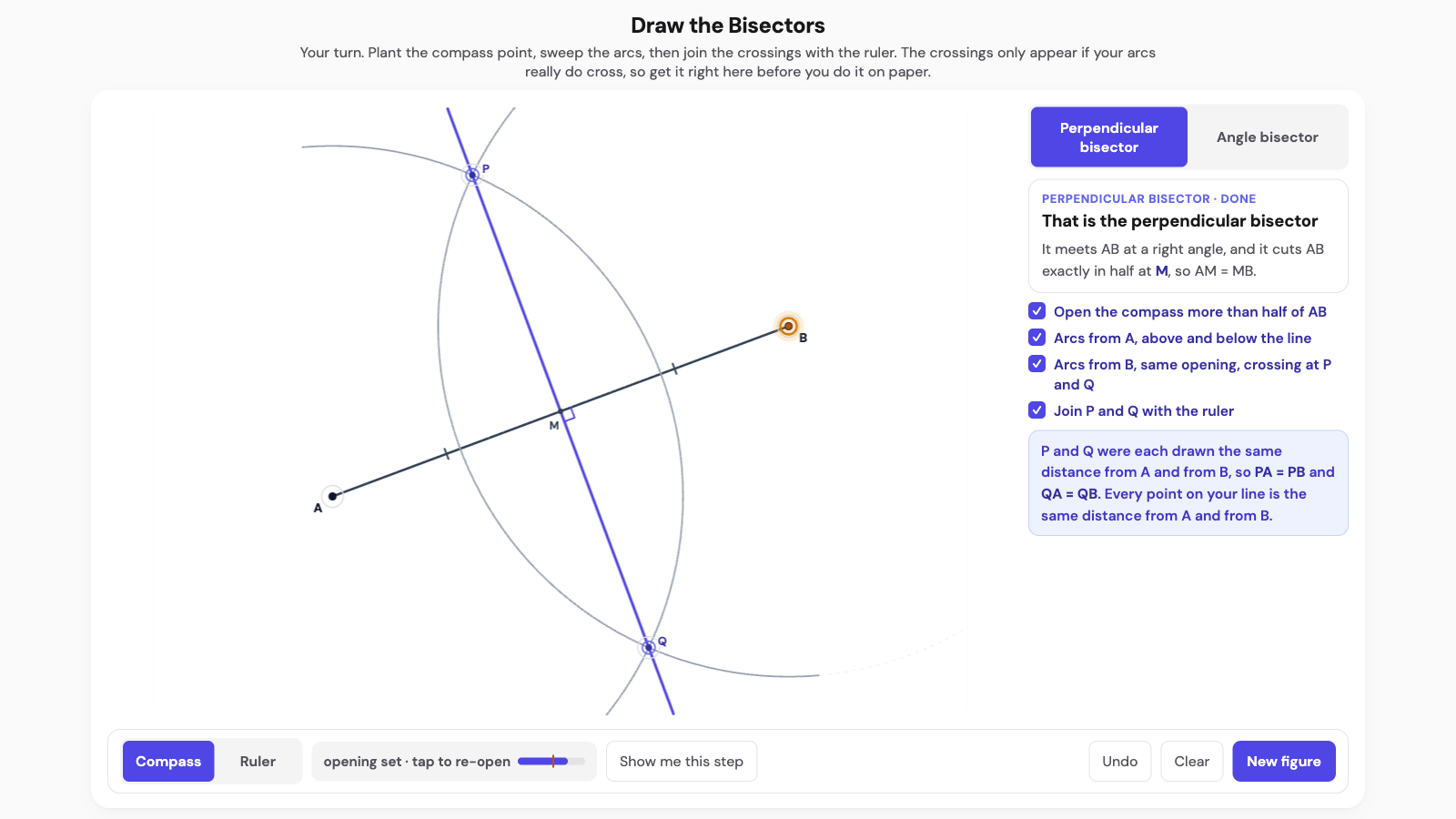
Draw the bisectors interactive. A segment AB with the student's own compass arcs crossing at P above and Q below, joined by a ruled line that meets AB at a right angle, beside a checklist of four construction steps.

Draw the Bisectors

Sec 3 · E Math Ch 9 · Congruence and Similarity Tests

Your turn with the compass. Plant the point, sweep the arcs, then join the crossings. The crossings only appear if your arcs really cross, so an opening that is too small leaves nothing to join.

Open interactive
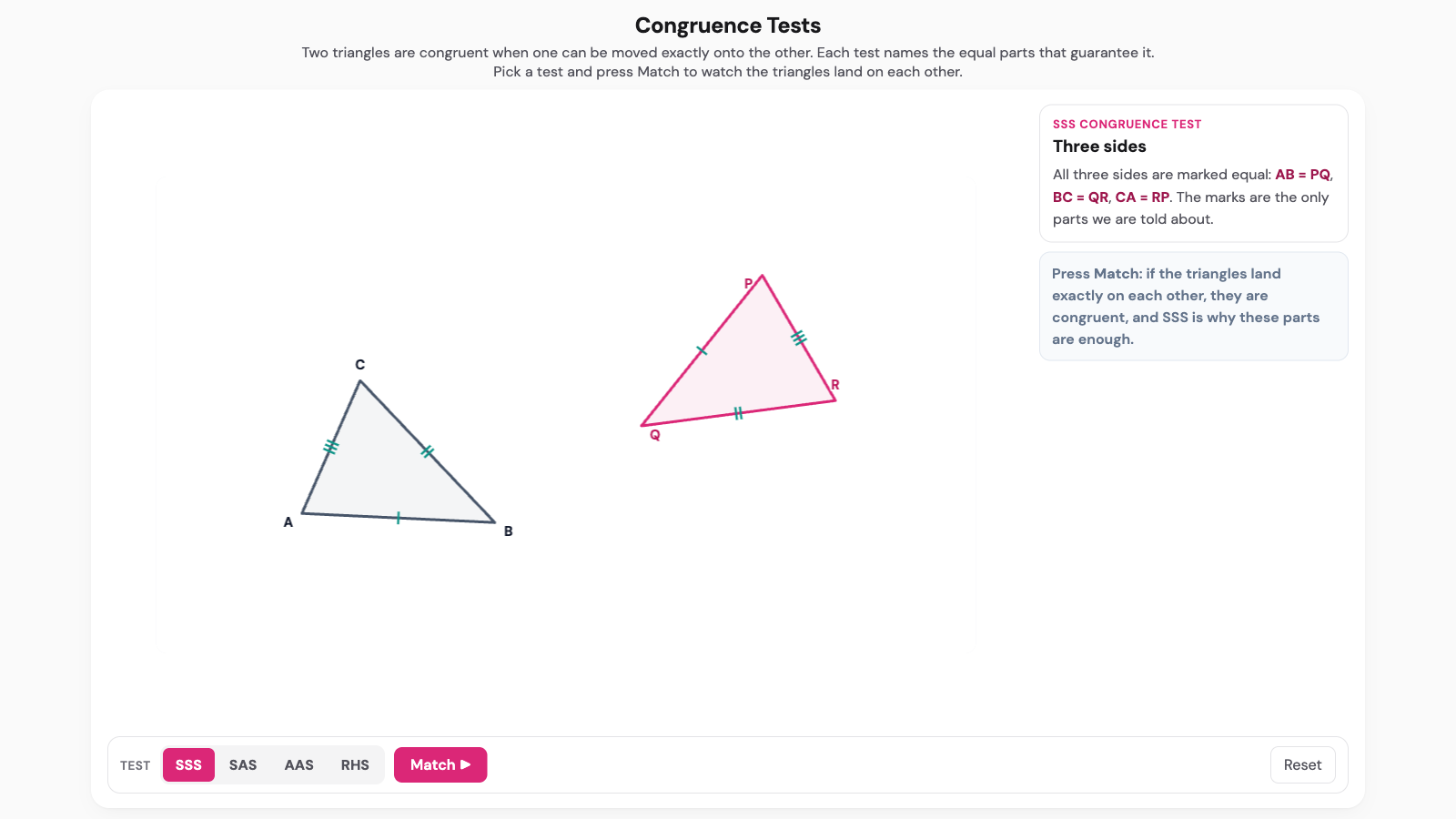
Congruence tests interactive. Two triangles side by side with matching sides tick-marked, ready to be slid onto each other to show they are congruent.

Congruence Tests

Sec 3 · E Math Ch 9 · Congruence and Similarity Tests

Congruent means one triangle fits exactly onto the other. Pick a test (SSS, SAS, AAS, RHS), press Match, and watch one triangle slide and turn to land on the other.

Open interactive
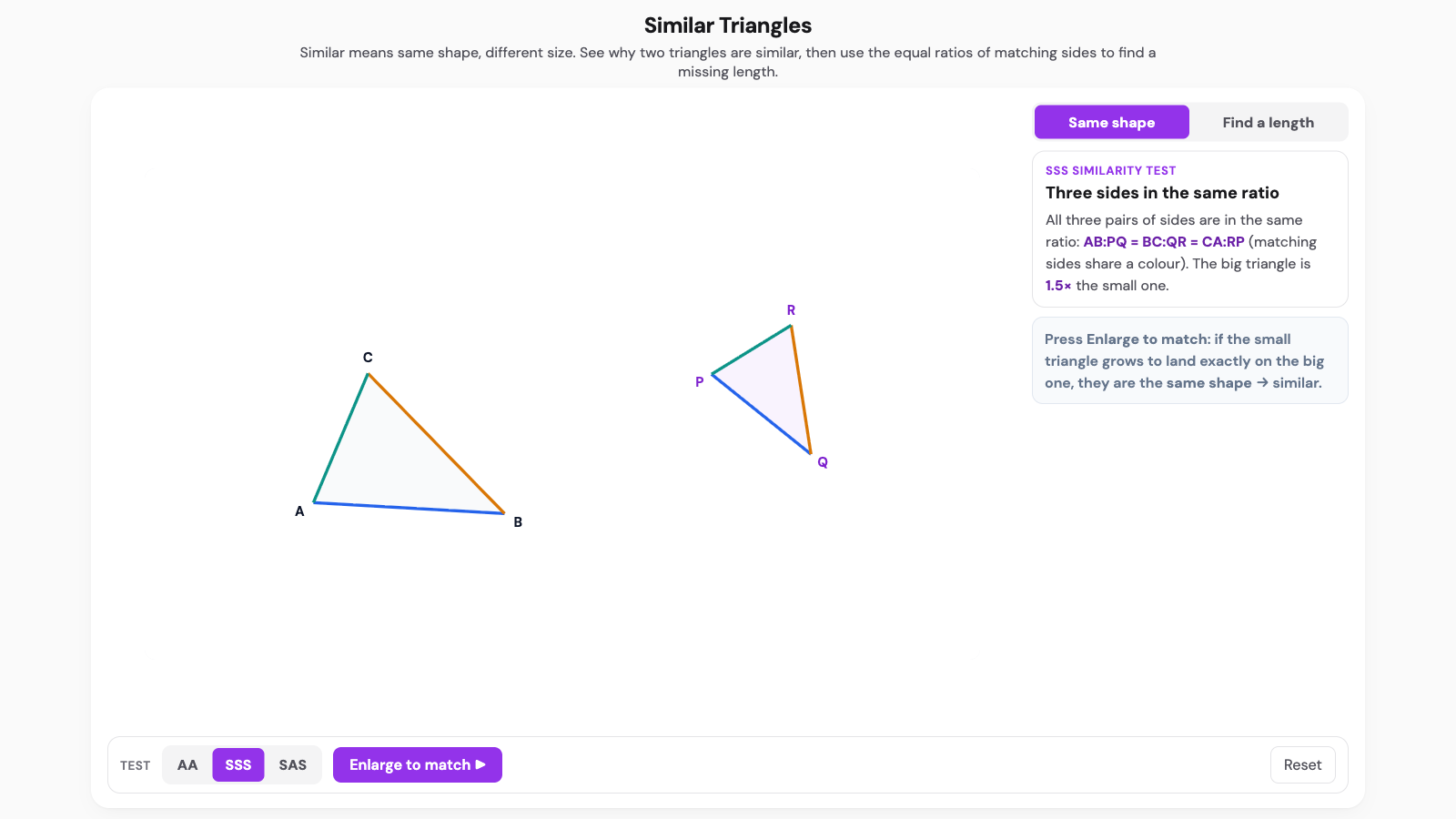
Similar triangles interactive. A small triangle and a larger triangle of the same shape, with matching sides colour-coded to show they are in the same ratio.

Similar Triangles

Sec 3 · E Math Ch 9 · Congruence and Similarity Tests

Same shape, different size. See why two triangles are similar (AA, SSS, SAS, enlarge to match), then use the equal ratios of matching sides to find a missing length.

Open interactive
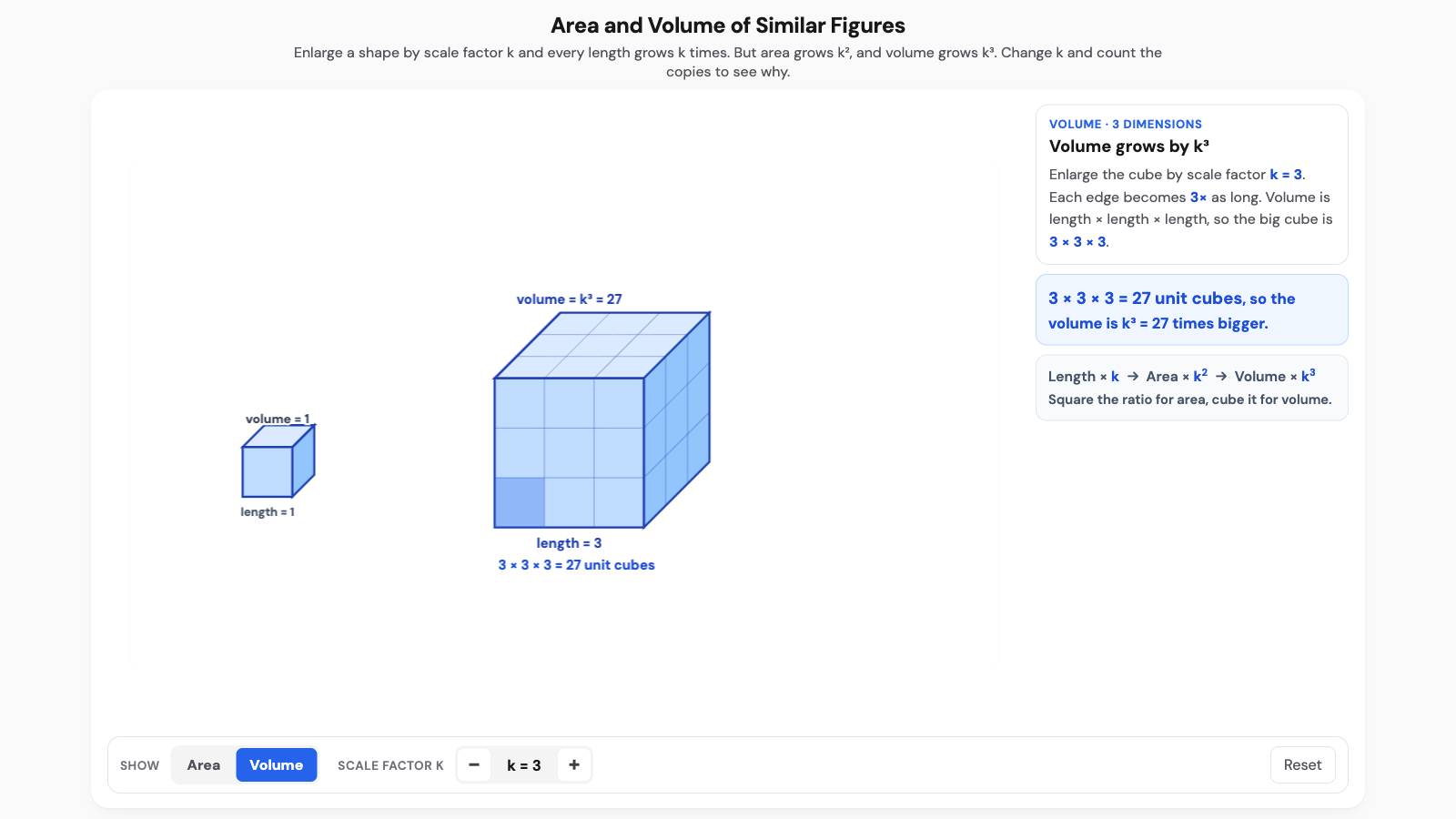
Area and volume of similar figures interactive. A unit cube beside a 3 by 3 by 3 cube built from 27 unit cubes, showing volume grows by k cubed.

Area and Volume of Similar Figures

Sec 3 · E Math Ch 10 · Area and Volume of Similar Figures and Solids

Enlarge by scale factor k and every length grows k times, but area grows k² and volume grows k³. Count the unit squares and cubes to see why: square the ratio for area, cube it for volume.

Open interactive
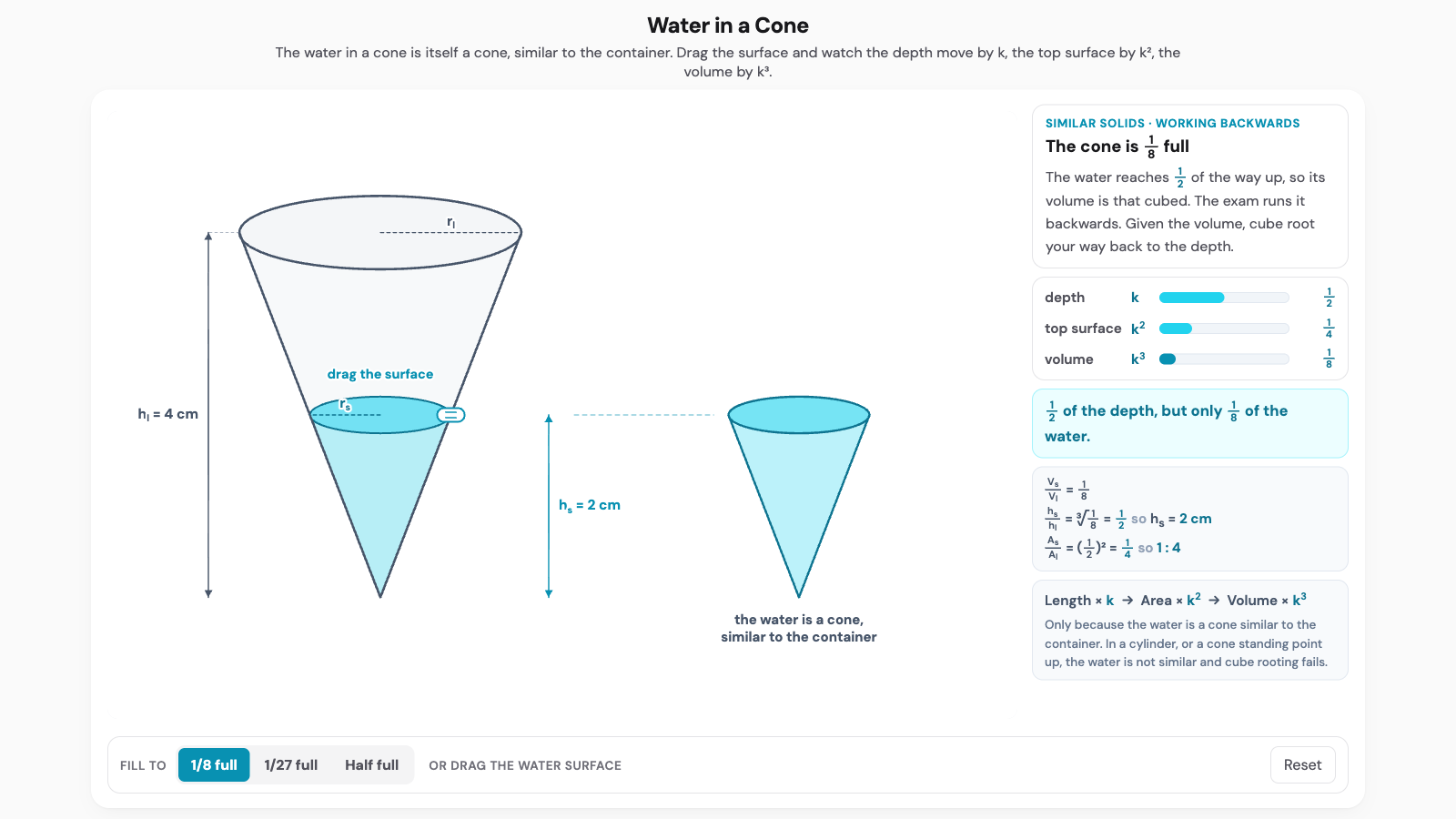
Water in a cone interactive. An inverted conical container filled to half its depth, with the water drawn again beside it as a smaller similar cone.

Water in a Cone

Sec 3 · E Math Ch 10 · Area and Volume of Similar Figures and Solids

A part-filled cone, where the water is itself a cone similar to the container. One-eighth full puts the surface at half the depth, not an eighth. Drag the surface, or work back from the volume with a cube root.

Open interactive
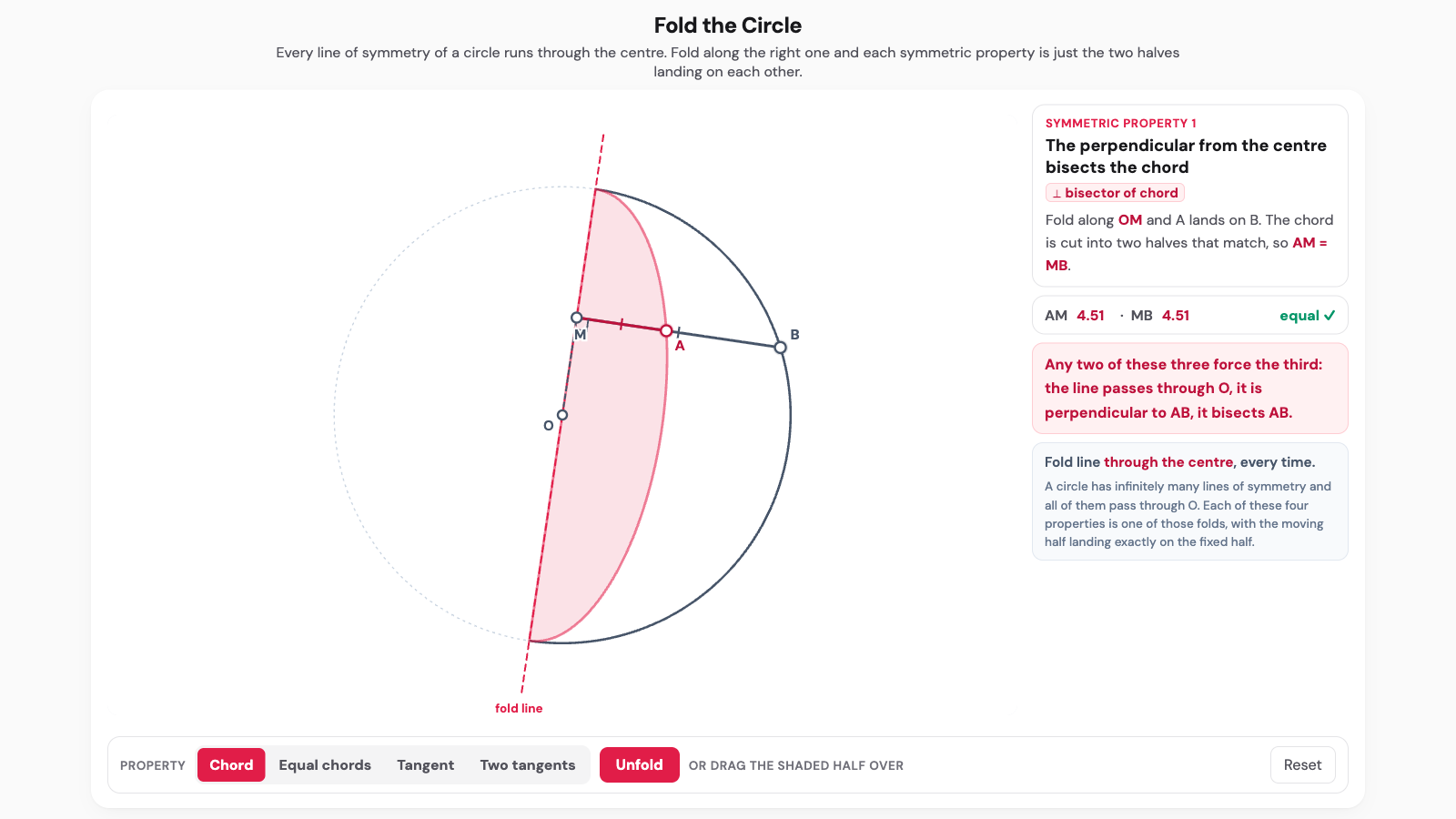
Fold the Circle interactive. A circle with a chord, one half shaded and caught part way through folding across a line through the centre.

Fold the Circle

Sec 3 · E Math Ch 11 · Geometrical Properties of Circles

All four symmetric properties as a single fold. Fold along the right line through the centre and the two halves land on each other, which is where every one of them comes from.

Open interactive
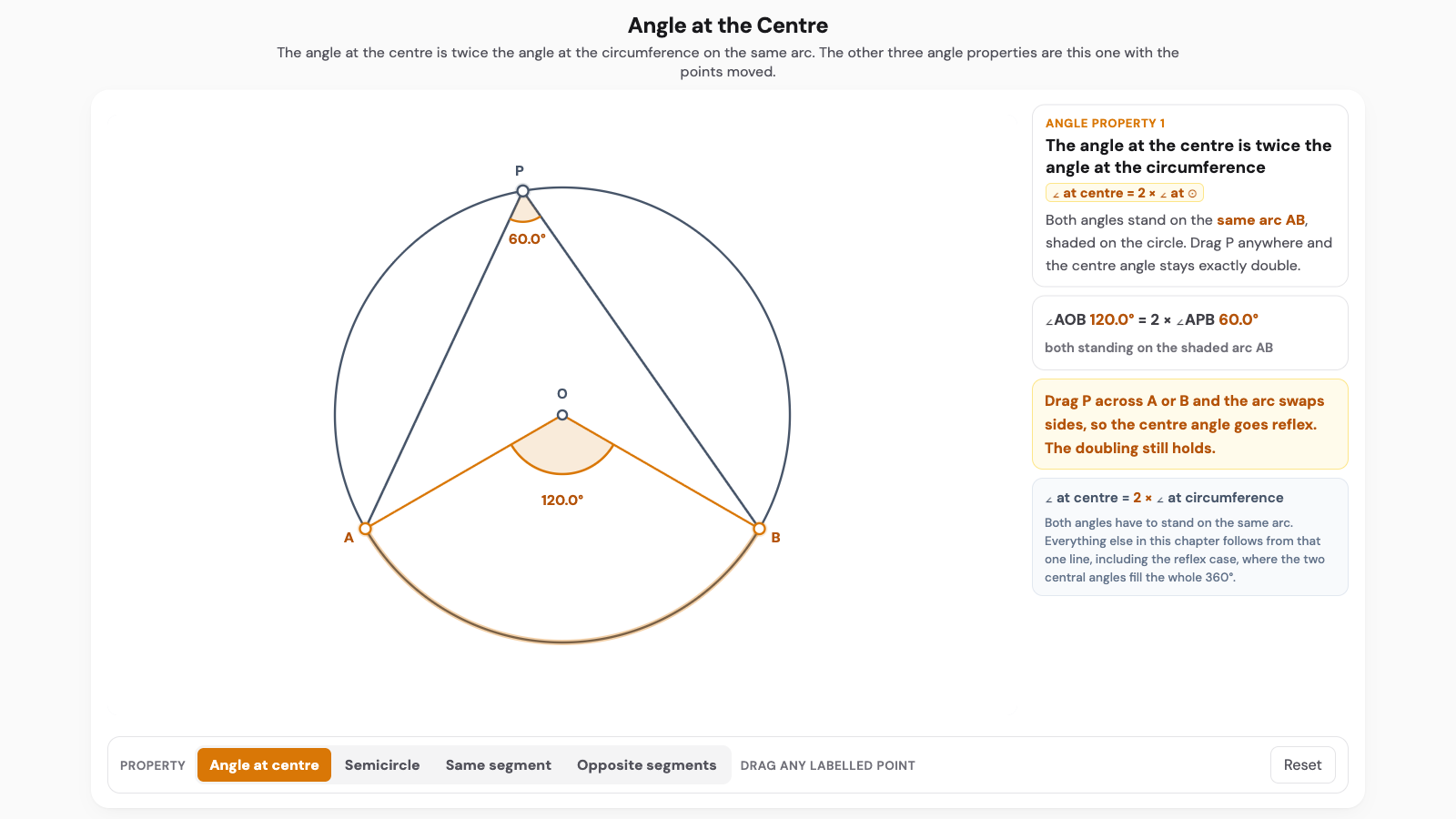
Angle at the Centre interactive. A circle with points A, B and P, showing a 120 degree angle at the centre and the 60 degree angle at the circumference standing on the same arc.

Angle at the Centre

Sec 3 · E Math Ch 11 · Geometrical Properties of Circles

The angle at the centre is twice the angle at the circumference on the same arc. Drag the points and the other three angle properties fall out of that one line, reflex case included.

Open interactive
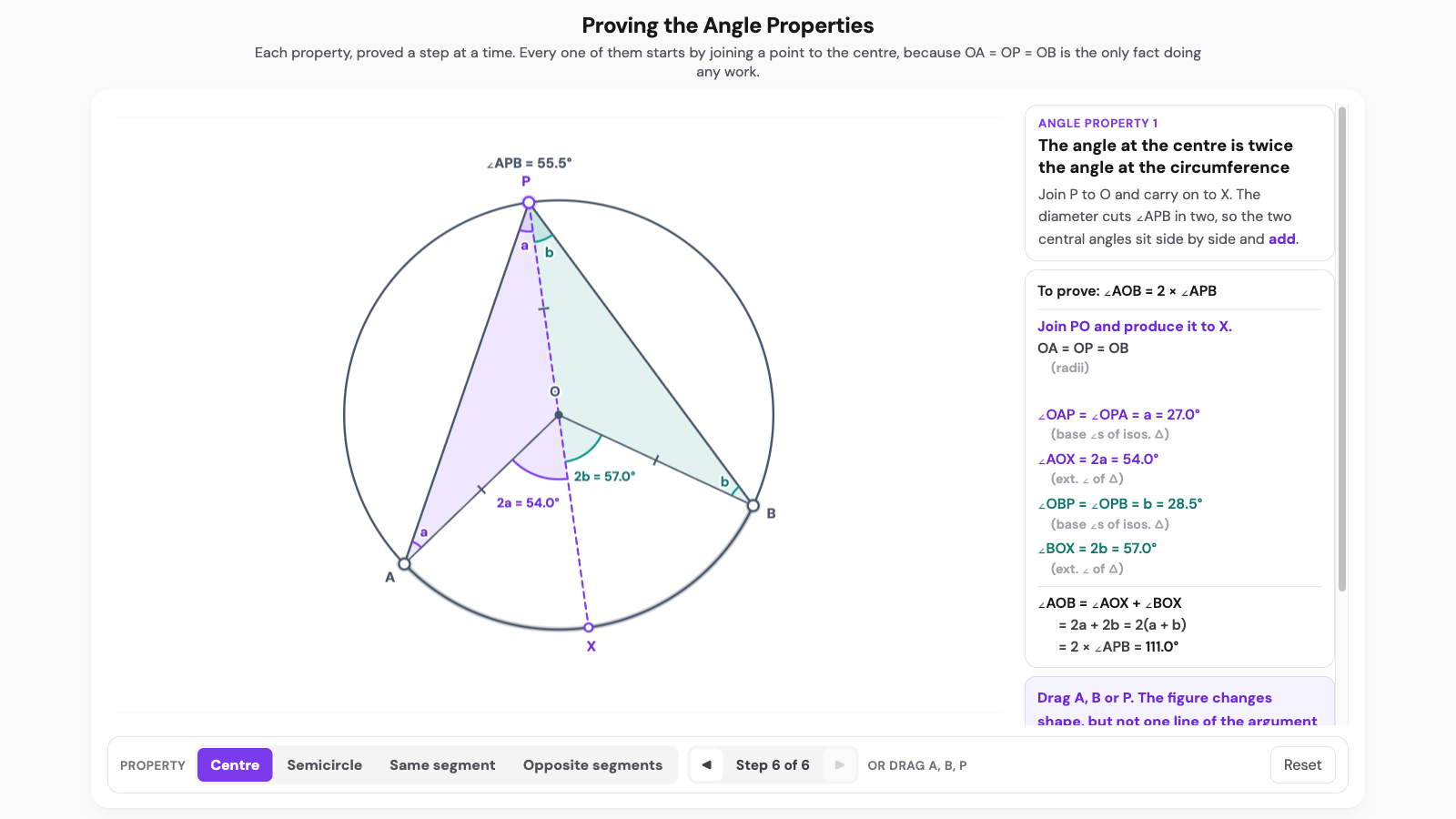
Proving the Angle Properties interactive. A circle with two shaded isosceles triangles meeting at the centre, a dashed diameter from P through O to X, and the angles a, 2a, b and 2b marked.

Proving the Angle Properties

Sec 3 · E Math Ch 11 · Geometrical Properties of Circles

All four angle properties, proved a step at a time from a blank figure. Every proof starts by joining a point to the centre, because OA = OP = OB is the only fact doing any work.

Open interactive
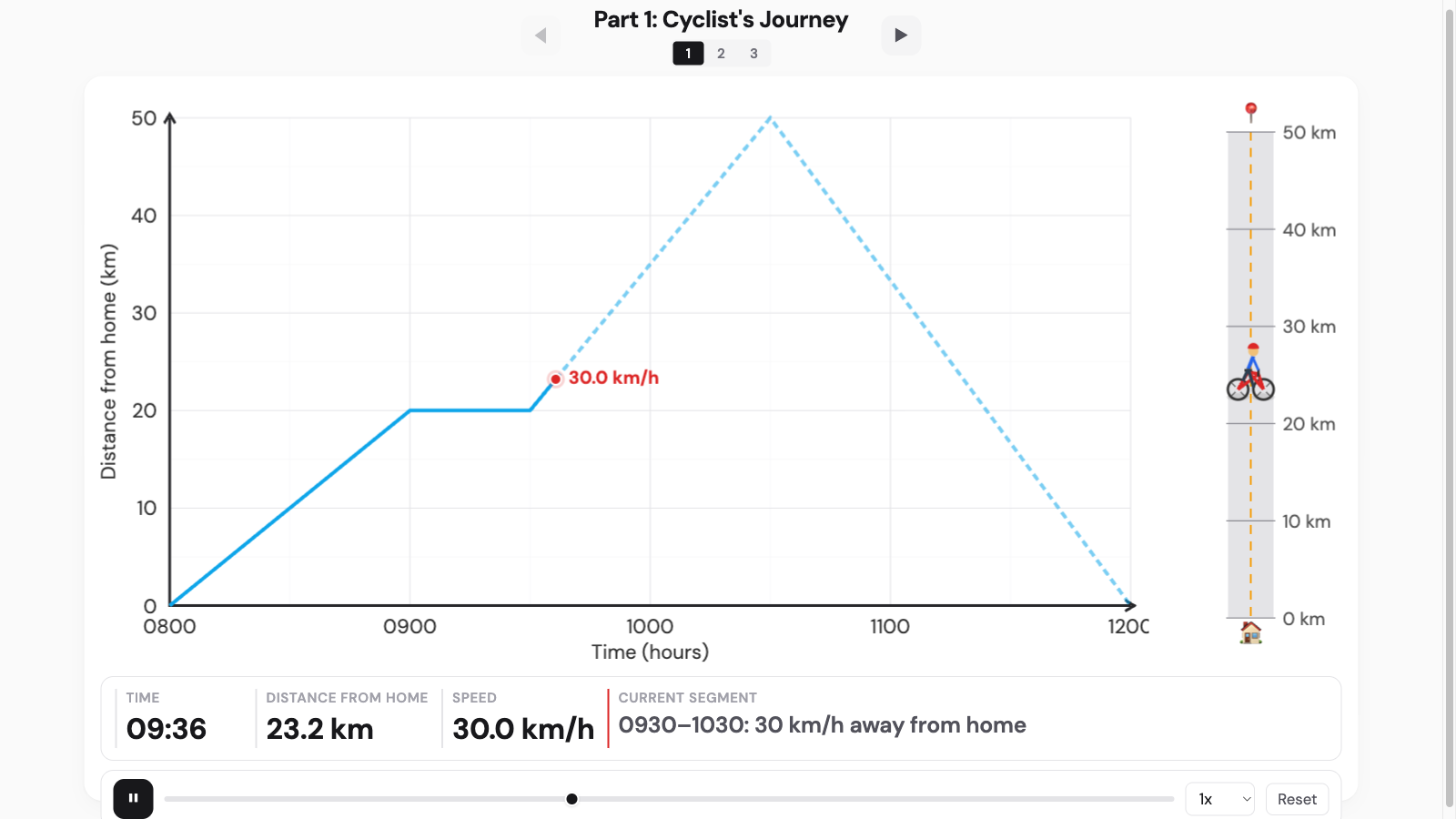
Speed interactive — cyclist's journey on a distance–time graph

Speed

Sec 3 · E Math Ch 5 · Graphs of Functions and Graphical Solution

Read speed and motion from distance–time graphs across three scenes.

Open interactive
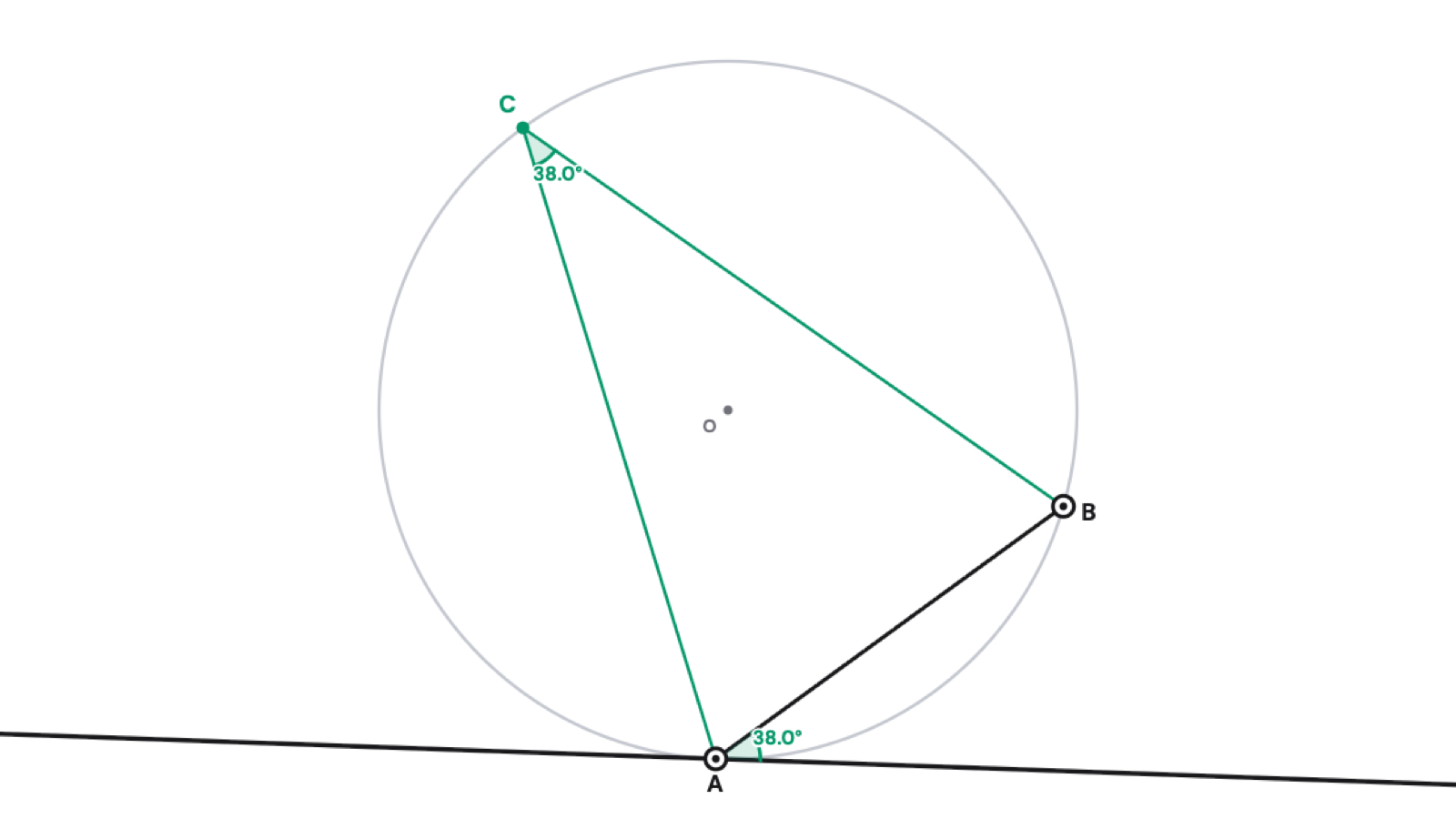
Alternate segment theorem interactive. A tangent and chord on a circle, showing the tangent-chord angle equal to the angle in the alternate segment, with the centre-of-circle proof.

Alternate Segment Theorem

Sec 4 · A Math Ch 17 · Proofs in Plane Geometry

Drag the points around a circle to see the tangent-chord angle equal the angle in the alternate segment, then step through the proof.

Open interactive
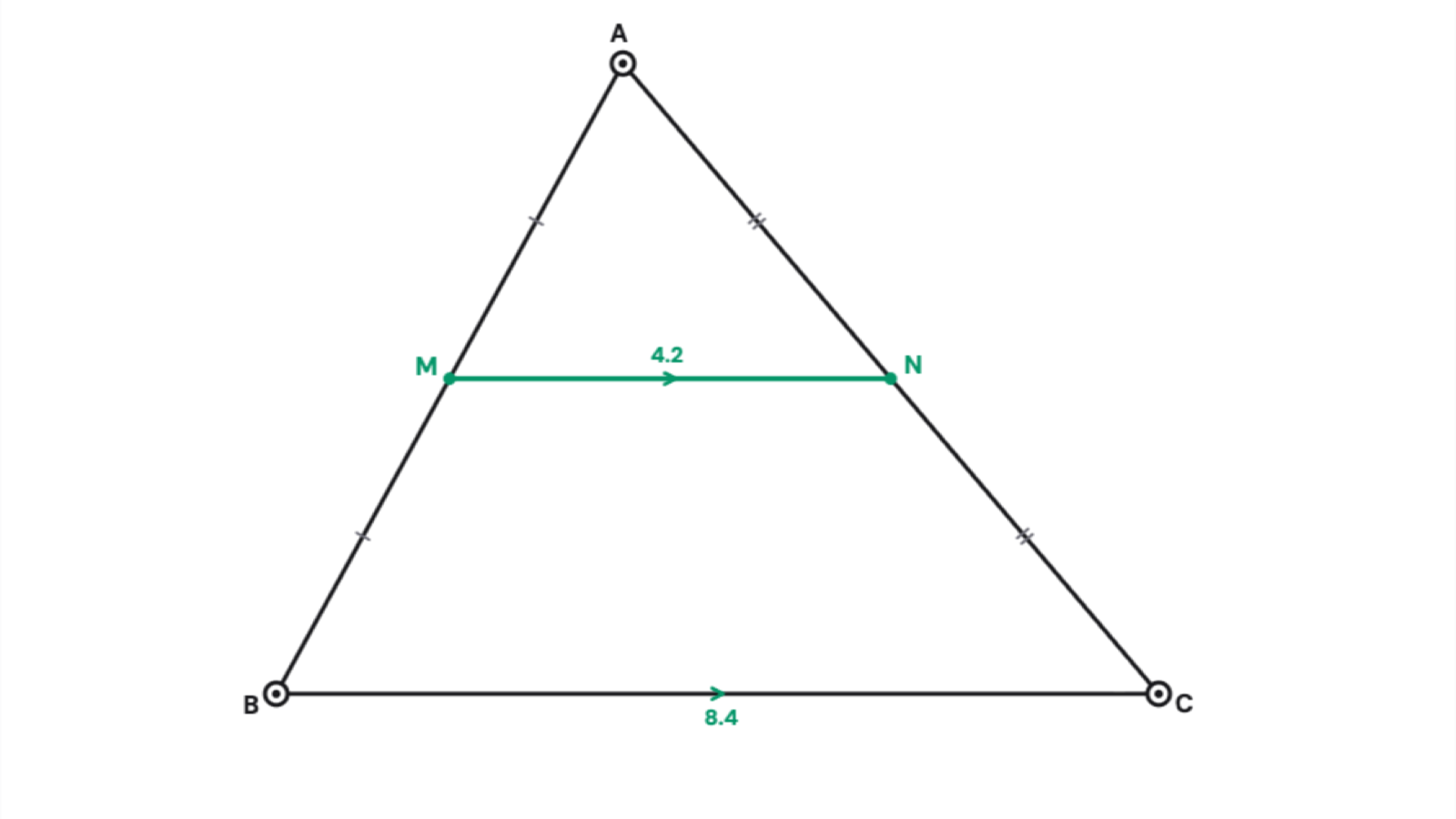
Midpoint theorem interactive. A triangle with the segment joining two midpoints, parallel to the third side and half its length, with the similar-triangles proof.

Midpoint Theorem

Sec 4 · A Math Ch 17 · Proofs in Plane Geometry

Drag a triangle and watch the segment joining two midpoints stay parallel to the third side and exactly half its length, then step through the proof.

Open interactive
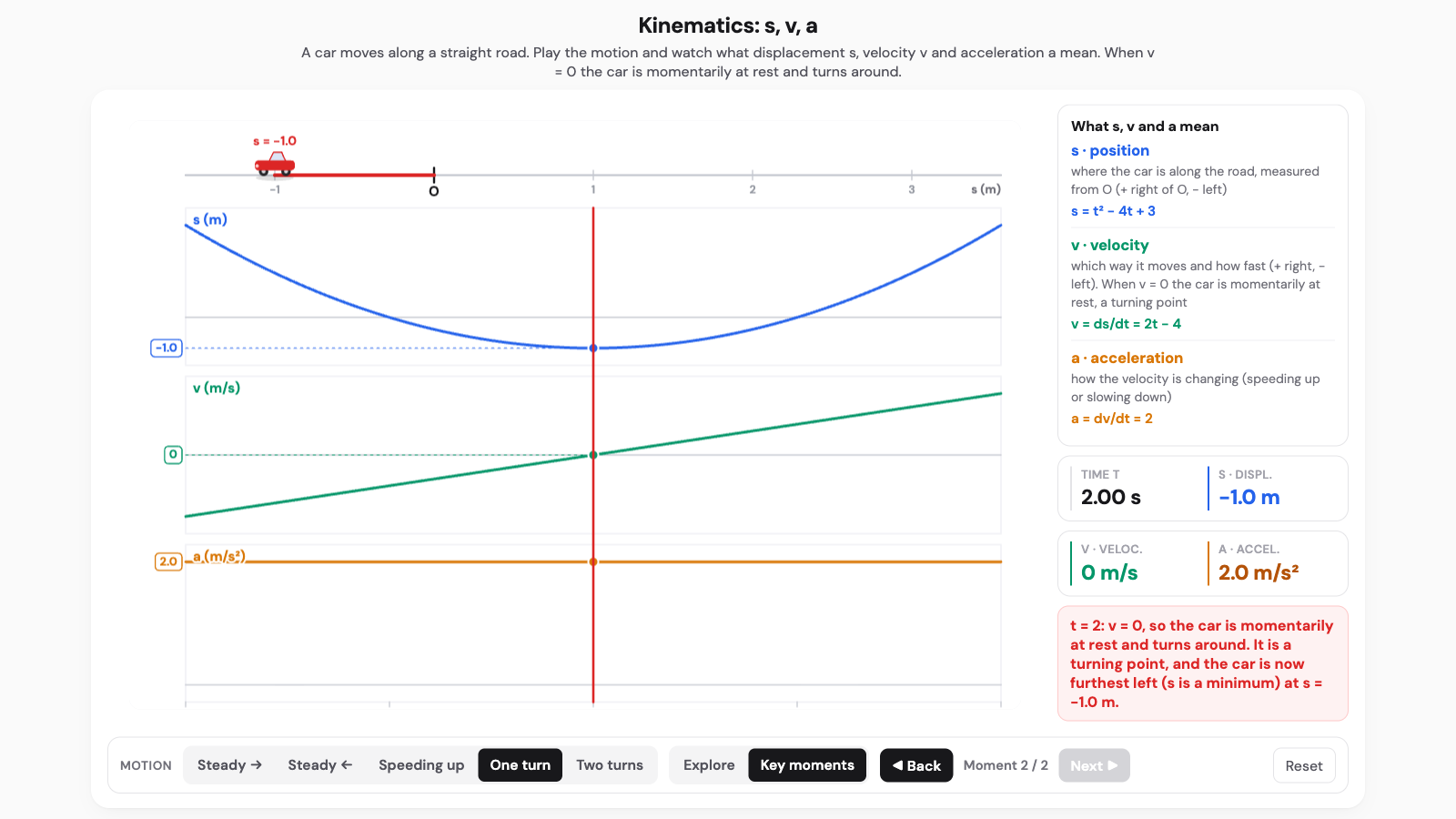
Kinematics interactive. A car moving along a number line above time-aligned displacement, velocity and acceleration graphs, with v = 0 marking a turning point.

Kinematics

Sec 4 · A Math Ch 16 · Kinematics

Drive a car along a road and see how displacement s, velocity v and acceleration a connect, and why v = 0 is a turning point.

Open interactive
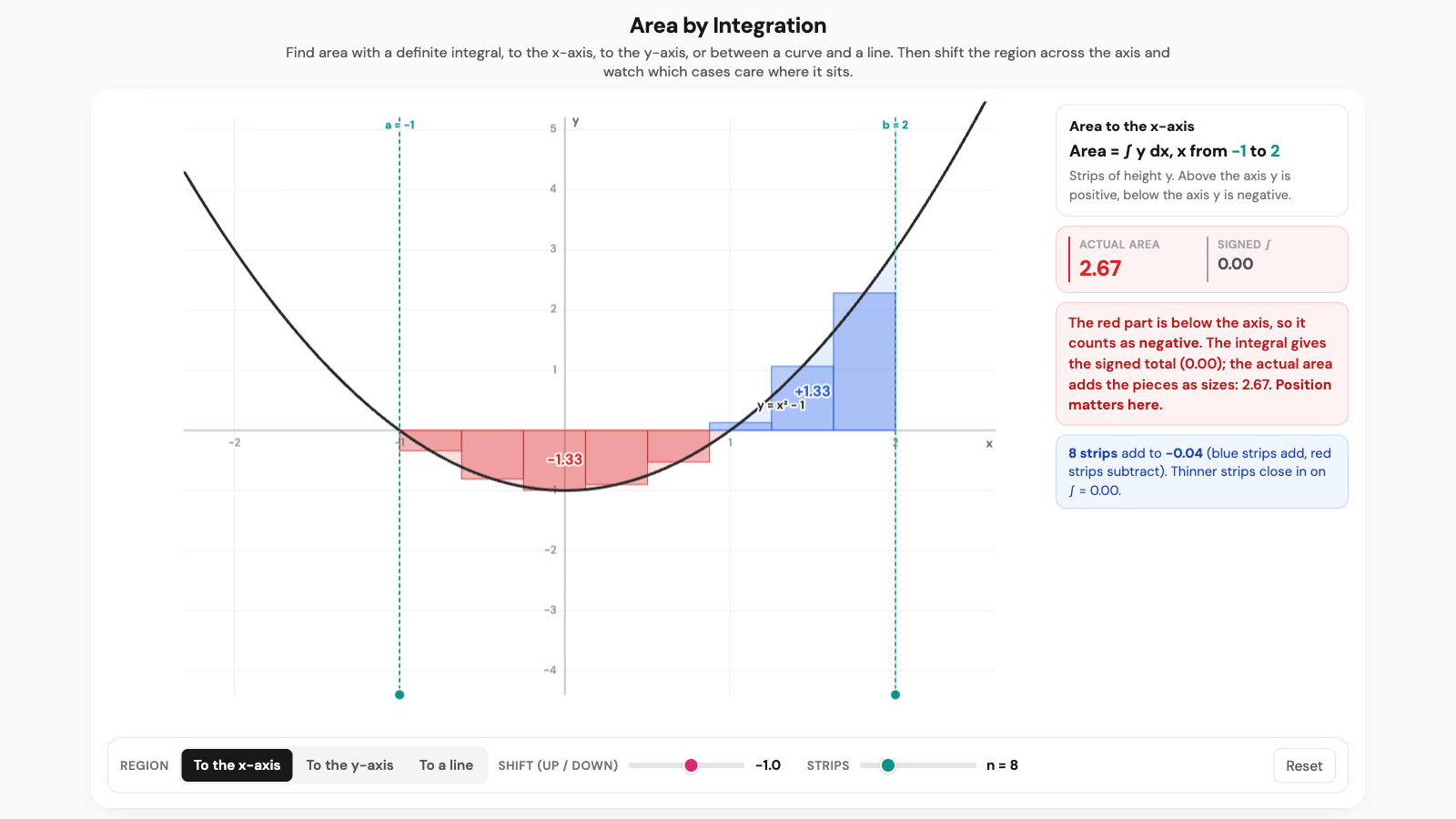
Area by Integration interactive. A region under a curve split into a red piece below the x-axis and a blue piece above, with strips summing to the integral.

Area by Integration

Sec 4 · A Math Ch 15 · Applications of Integration

Find area to the x-axis, the y-axis, or between a curve and a line, then shift it across the axis to see which cases turn negative and which do not.

Open interactive
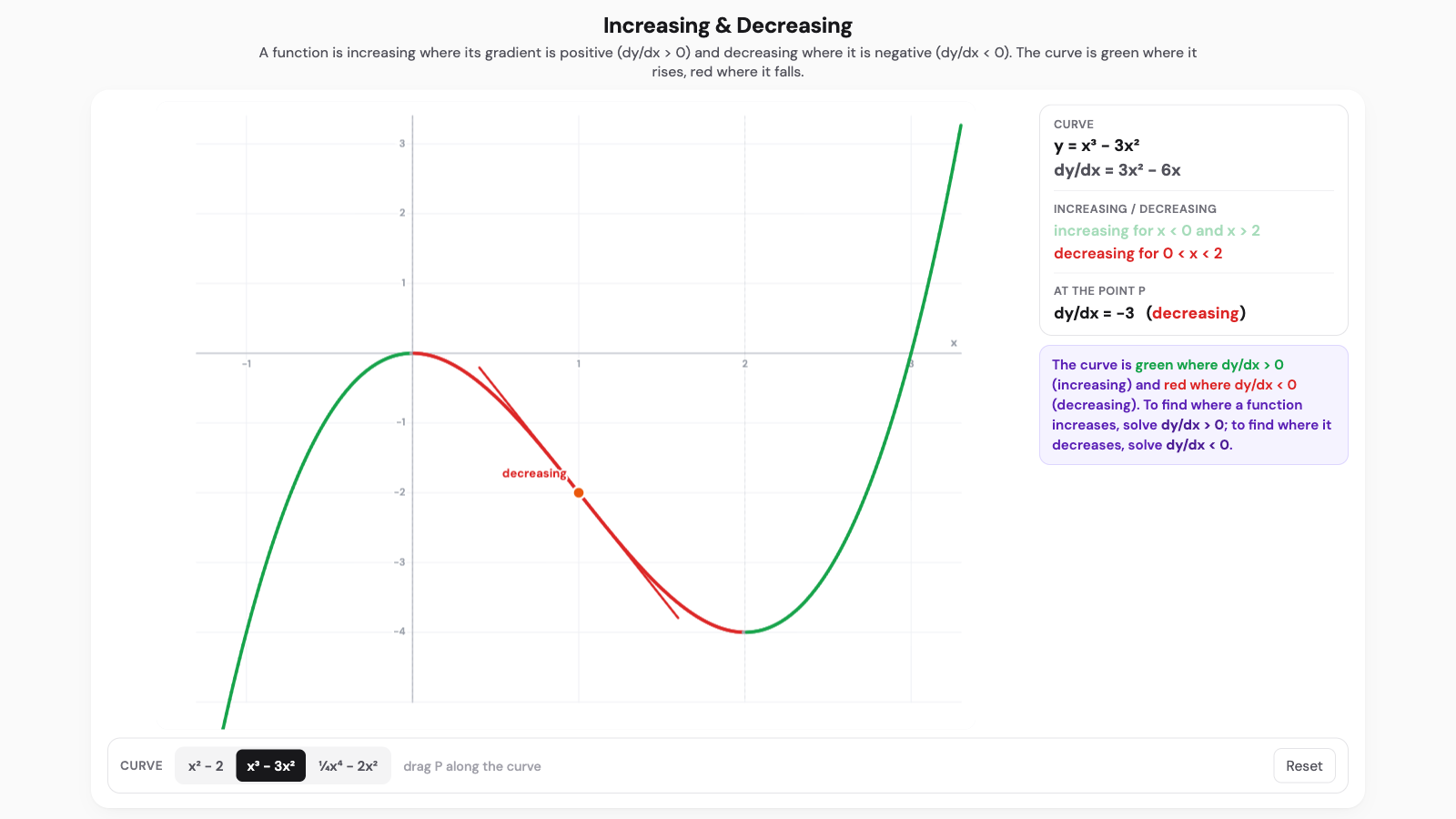
Increasing and Decreasing functions interactive. A curve drawn green where it rises and red where it falls, with the ranges of x where the gradient is positive or negative.

Increasing & Decreasing

Sec 4 · A Math Ch 12 · Applications of Differentiation

Drag a point along a curve to see where the function is increasing (dy/dx > 0) and decreasing (dy/dx < 0), and read off the ranges of x.

Open interactive
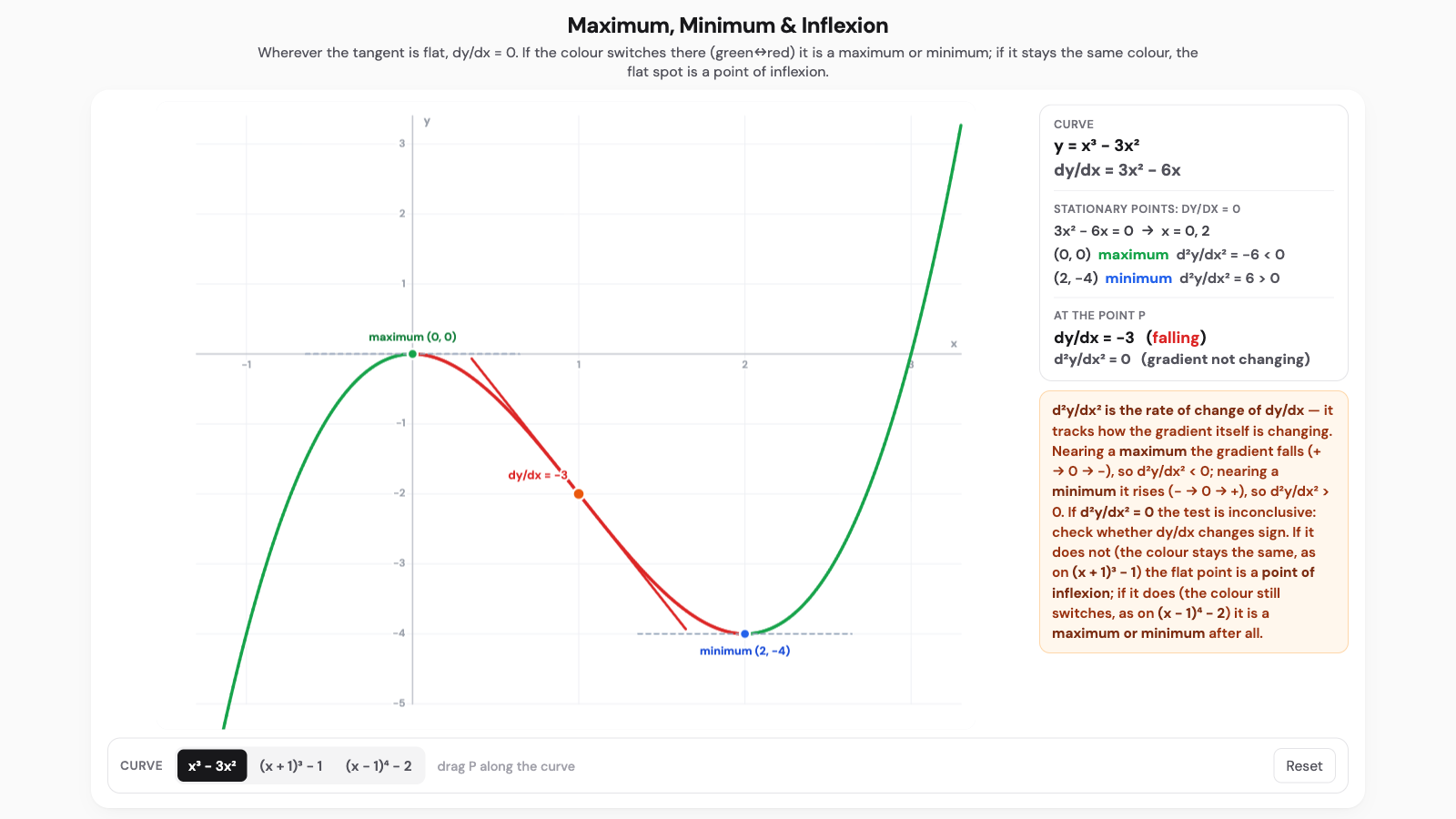
Maximum, Minimum and Inflexion interactive. A curve with its stationary points marked and classified by the sign of the second derivative, including a stationary point of inflexion.

Maximum, Minimum & Inflexion

Sec 4 · A Math Ch 12 · Applications of Differentiation

Drag a point to find where dy/dx = 0, and classify each stationary point as a maximum, minimum, or point of inflexion with the second derivative.

Open interactive
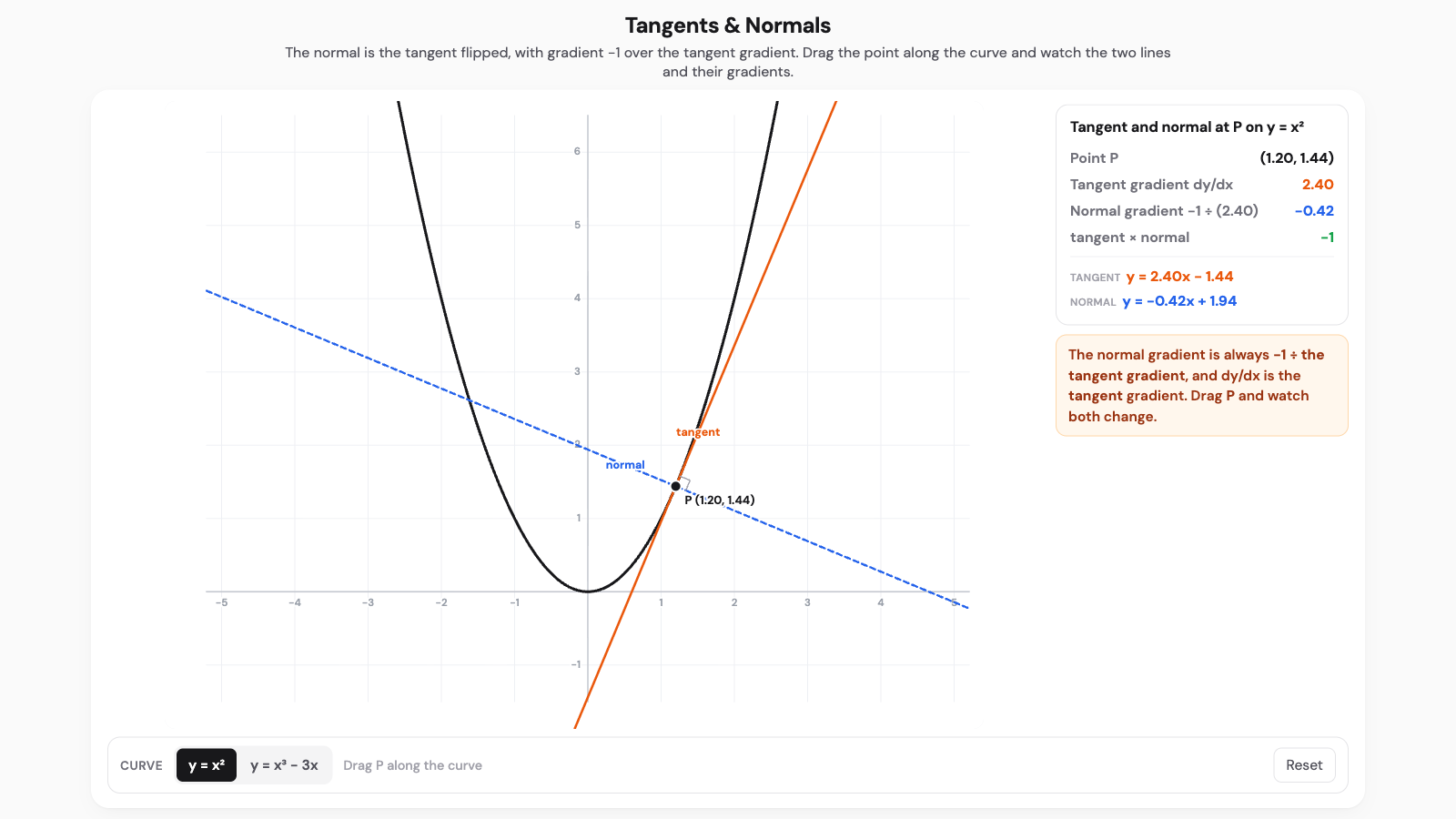
Tangents and Normals interactive. A point on a curve with its tangent and normal drawn, meeting at a right angle, their gradients multiplying to −1.

Tangents & Normals

Sec 4 · A Math Ch 12 · Applications of Differentiation

Drag a point along a curve to see the tangent and the normal, and why the normal gradient is −1 over the tangent gradient.

Open interactive
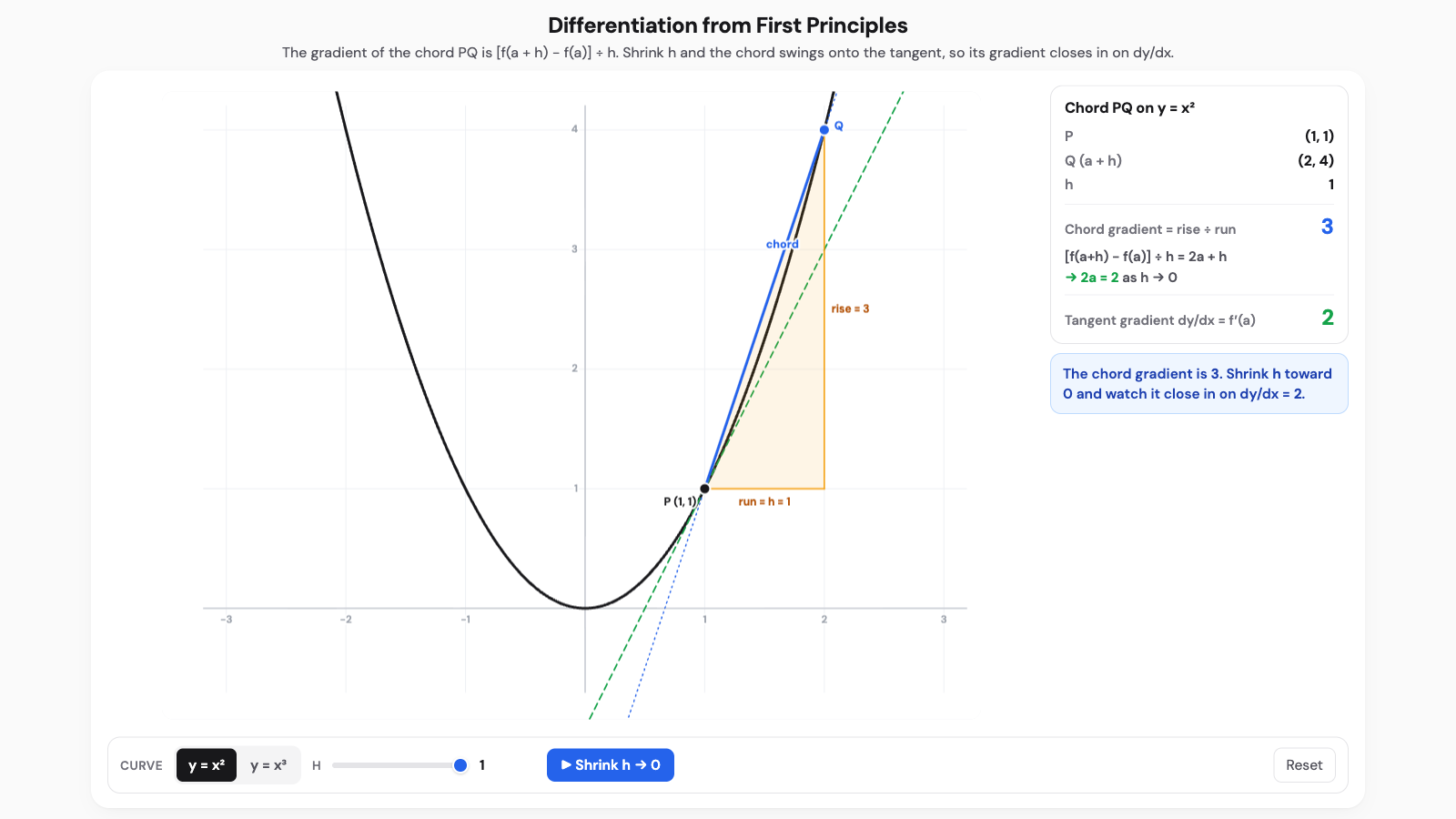
Differentiation from first principles interactive. A chord PQ on a curve and the tangent at P, with the chord gradient shrinking onto dy/dx as h gets small.

First Principles

Sec 4 · A Math Ch 11 · Gradients, Derivatives and Differentiation Techniques

Drag a point along a curve and shrink h to watch the chord PQ become the tangent, so its gradient closes in on dy/dx.

Open interactive
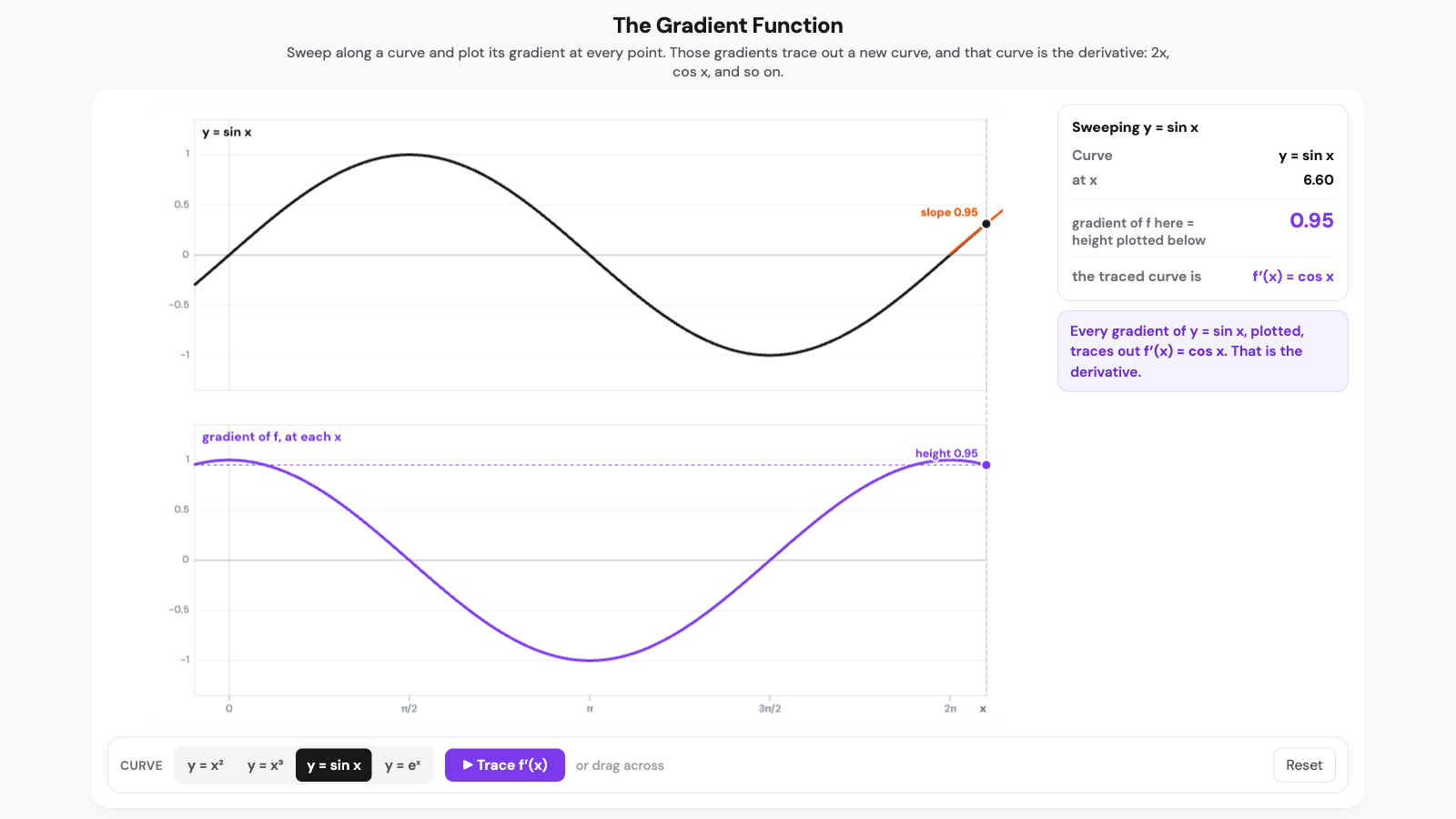
The gradient function interactive. Sweeping along sin x and plotting its gradient at each point traces out cos x on a second graph below.

The Gradient Function

Sec 4 · A Math Ch 11 & 13 · Differentiation

Sweep along a curve and plot its gradient at every point. Those gradients trace out the derivative, showing why x² gives 2x and sin x gives cos x.

Open interactive
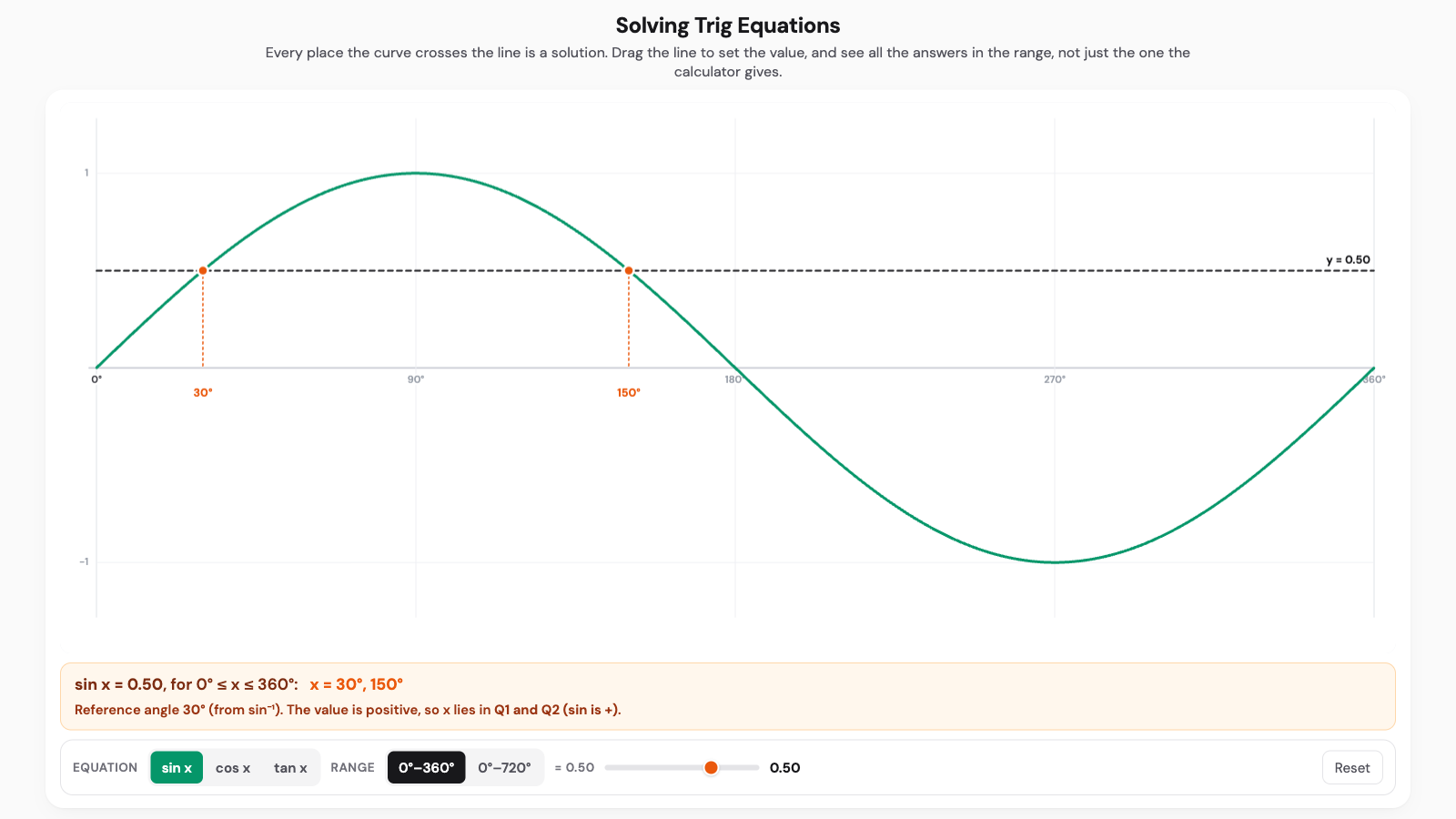
Solving trig equations interactive. A sine curve meets the line y = 0.5 at 30 and 150 degrees, both solutions marked.

Solving Trig Equations

Sec 3 · A Math Ch 10 · Trigonometric Equations and Identities

Drag a line across the curve and every crossing lights up as a solution, so students find all the answers in the range, not just the one the calculator gives.

Open interactive
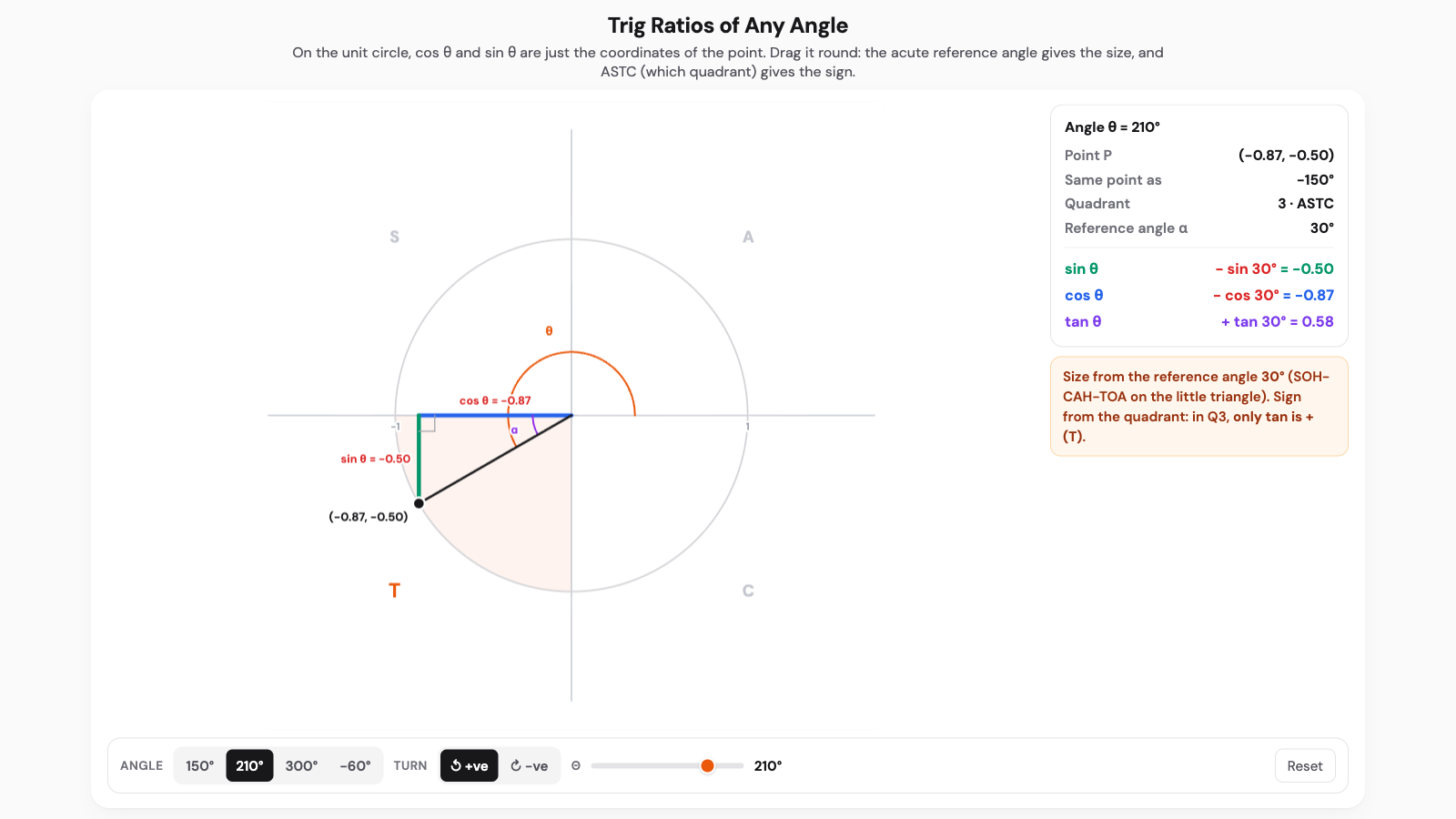
Trig ratios of any angle interactive. A point on the unit circle at 210 degrees, with the reference triangle, the ASTC quadrants, and sin, cos and tan read off with their signs.

Trig Ratios of Any Angle

Sec 3 · A Math Ch 9 · Trigonometric Functions and Graphs

Drag a point round the unit circle, where cos θ and sin θ are simply its coordinates. The acute reference angle gives the size and ASTC gives the sign, so tan of an obtuse or reflex angle stops being a guess.

Open interactive
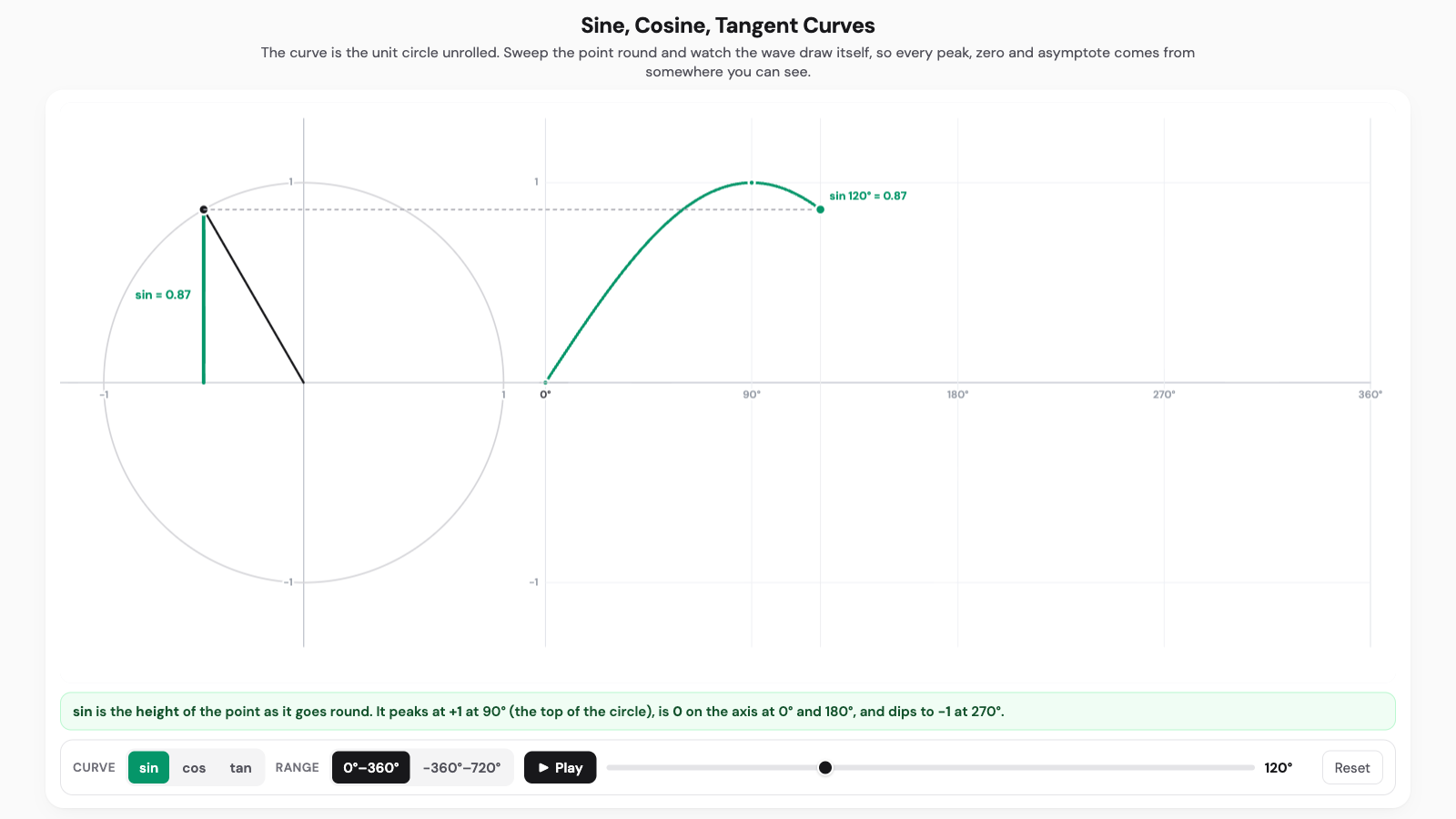
Sine, cosine, tangent curves interactive. A point on the unit circle with its height tied across to the sine wave being drawn on a graph.

Sine, Cosine & Tangent Curves

Sec 3 · A Math Ch 9 · Trigonometric Functions and Graphs

Watch each wave draw itself as a point sweeps the unit circle. sin is the height, cos is the base, and tan is the gradient of the line to the point.

Open interactive
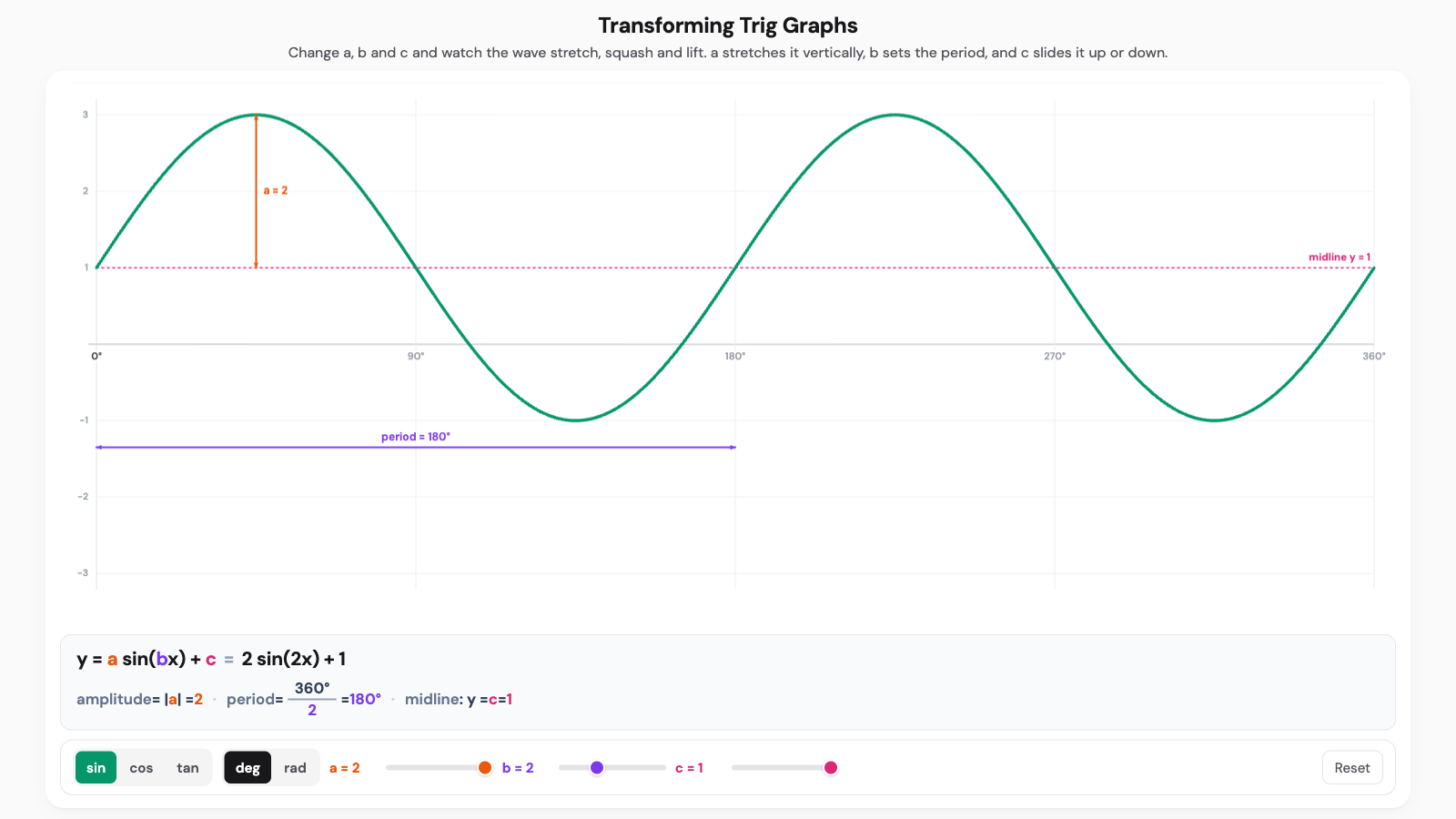
Transforming trig graphs interactive. A sine wave y = 2 sin(2x) + 1 with its amplitude, period and midline measured on the graph.

Transforming Trig Graphs

Sec 3 · A Math Ch 9 · Trigonometric Functions and Graphs

Drag a, b and c to stretch, squash and lift a sine, cosine or tangent graph, and read the amplitude, period and midline straight off the equation.

Open interactive
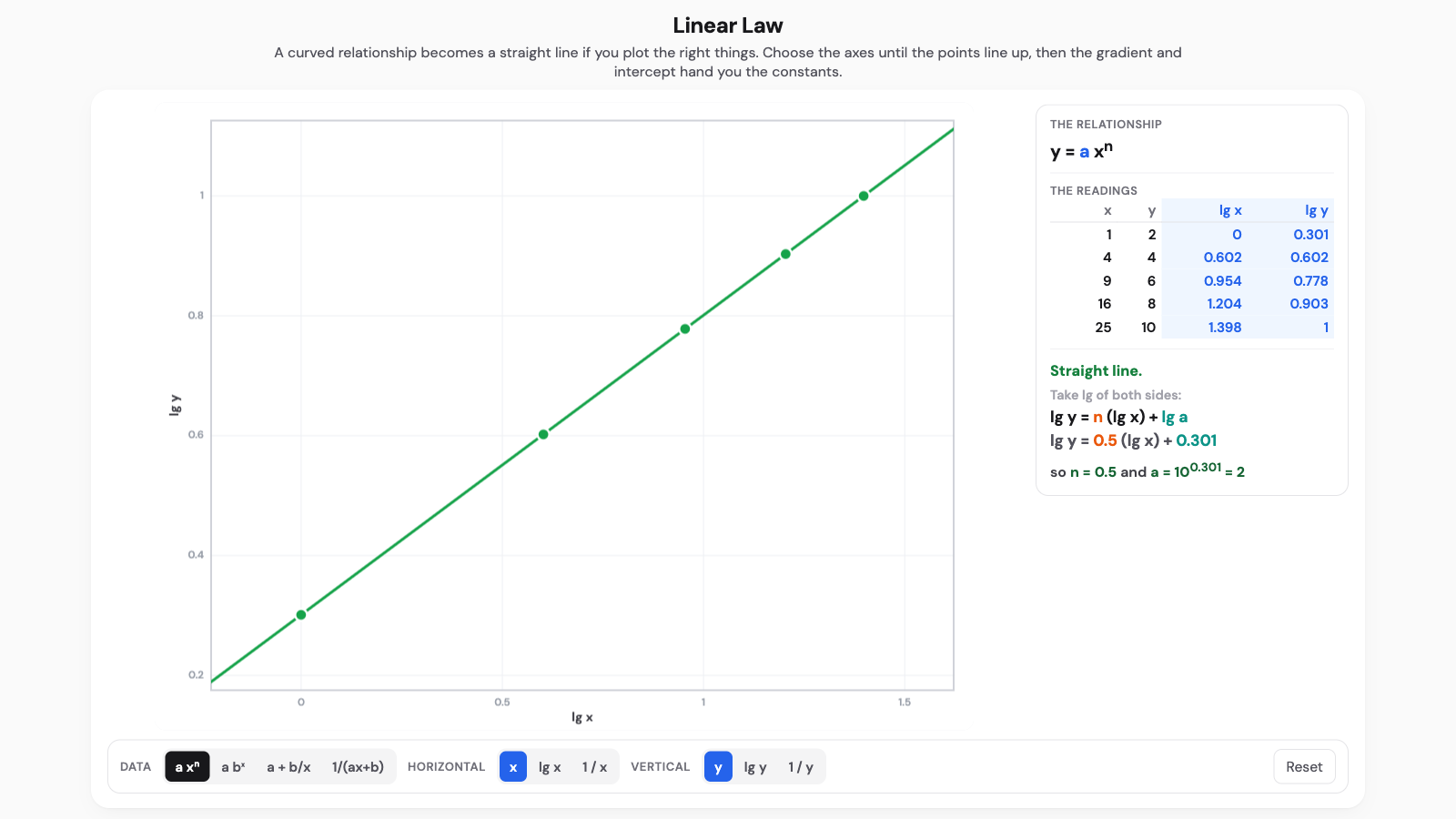
Linear Law interactive. A set of data points plotted as lg y against lg x falling onto a straight line, with the gradient and intercept giving the constants.

Linear Law

Sec 3 · A Math Ch 8 · Linear Law

Watch a curved scatter straighten when you plot the right axes, then read the constants off the gradient and intercept.

Open interactive
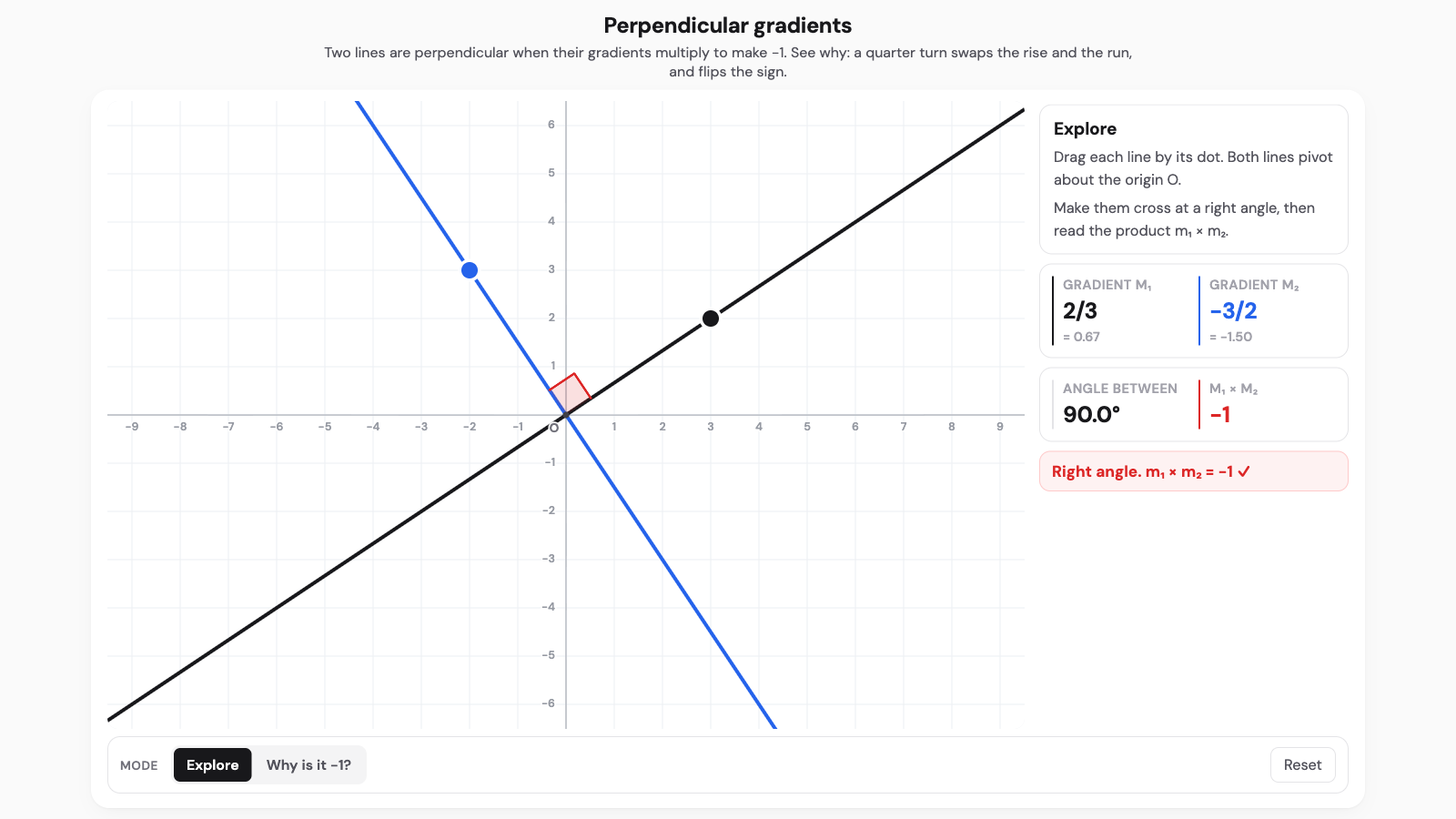
Perpendicular Gradients interactive. Two lines crossing at a right angle on a grid, with gradients that multiply to −1.

Perpendicular Gradients

Sec 3 · A Math Ch 7 · Coordinate Geometry

Drag two lines to a right angle, then watch a quarter turn show why their gradients multiply to make −1.

Open interactive
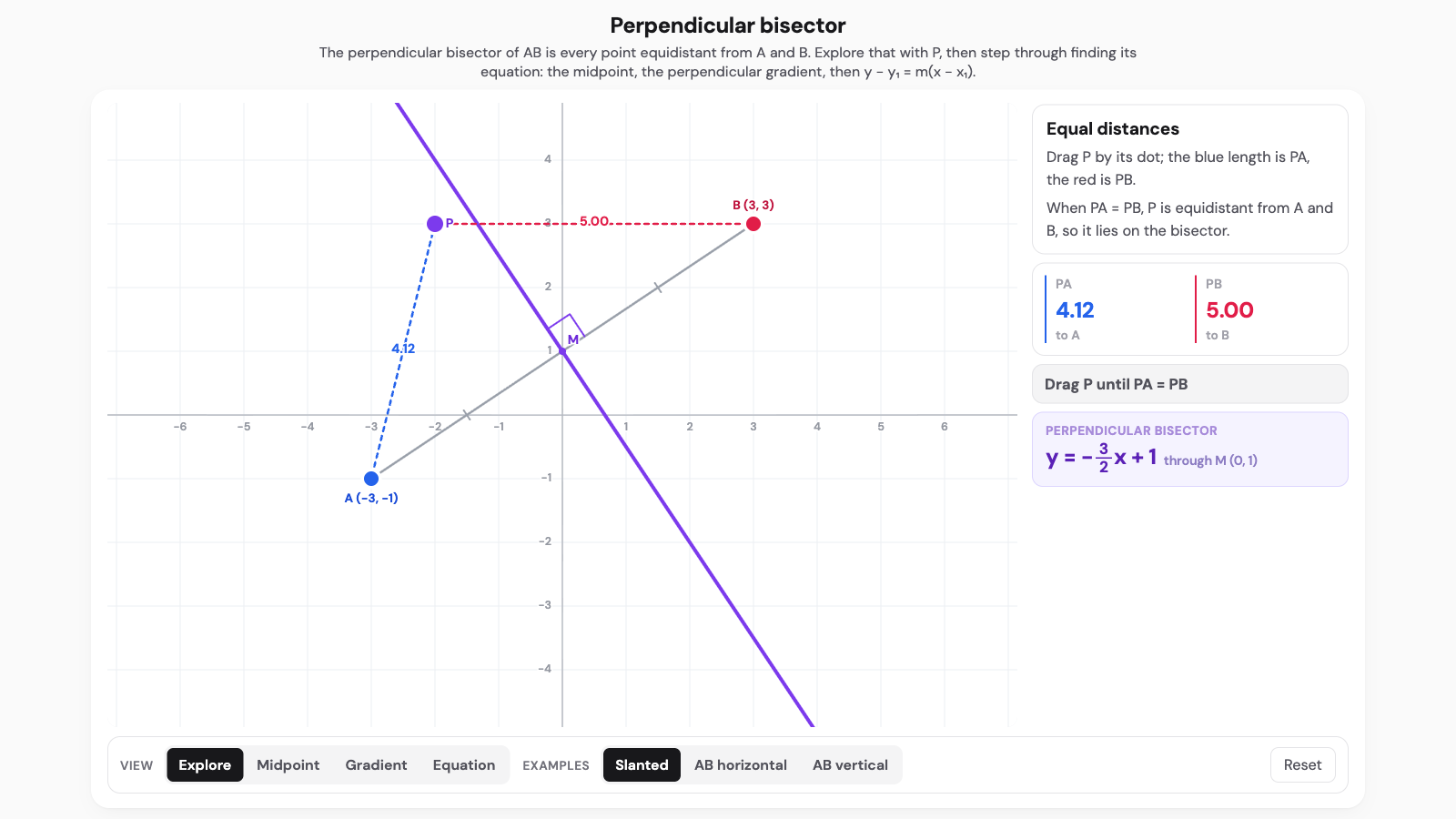
Perpendicular Bisector interactive. A segment AB with the perpendicular bisector through its midpoint at a right angle, and a point kept equidistant from A and B.

Perpendicular Bisector

Sec 3 · A Math Ch 7 · Coordinate Geometry

Drag P until it is equidistant from A and B to trace the bisector, then step through finding the line's equation from the midpoint and perpendicular gradient.

Open interactive
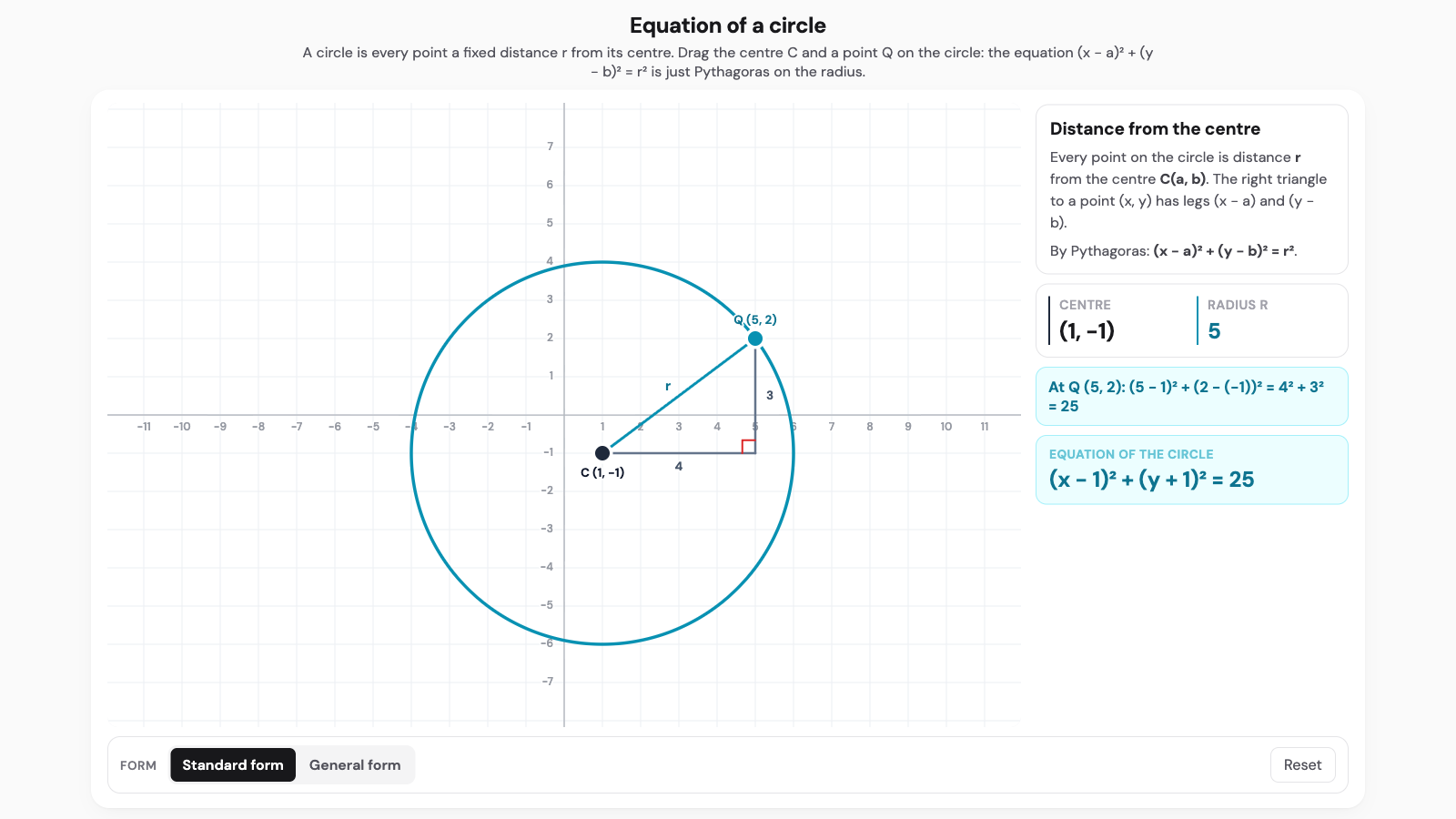
Equation of a circle interactive. A circle on a grid with a right triangle from the centre to a point on it, showing (x − a)² + (y − b)² = r².

Equation of a Circle

Sec 3 · A Math Ch 7 · Coordinate Geometry

Drag the centre and a point on the circle; (x − a)² + (y − b)² = r² falls out of Pythagoras on the radius, with the general form on a second tab.

Open interactive
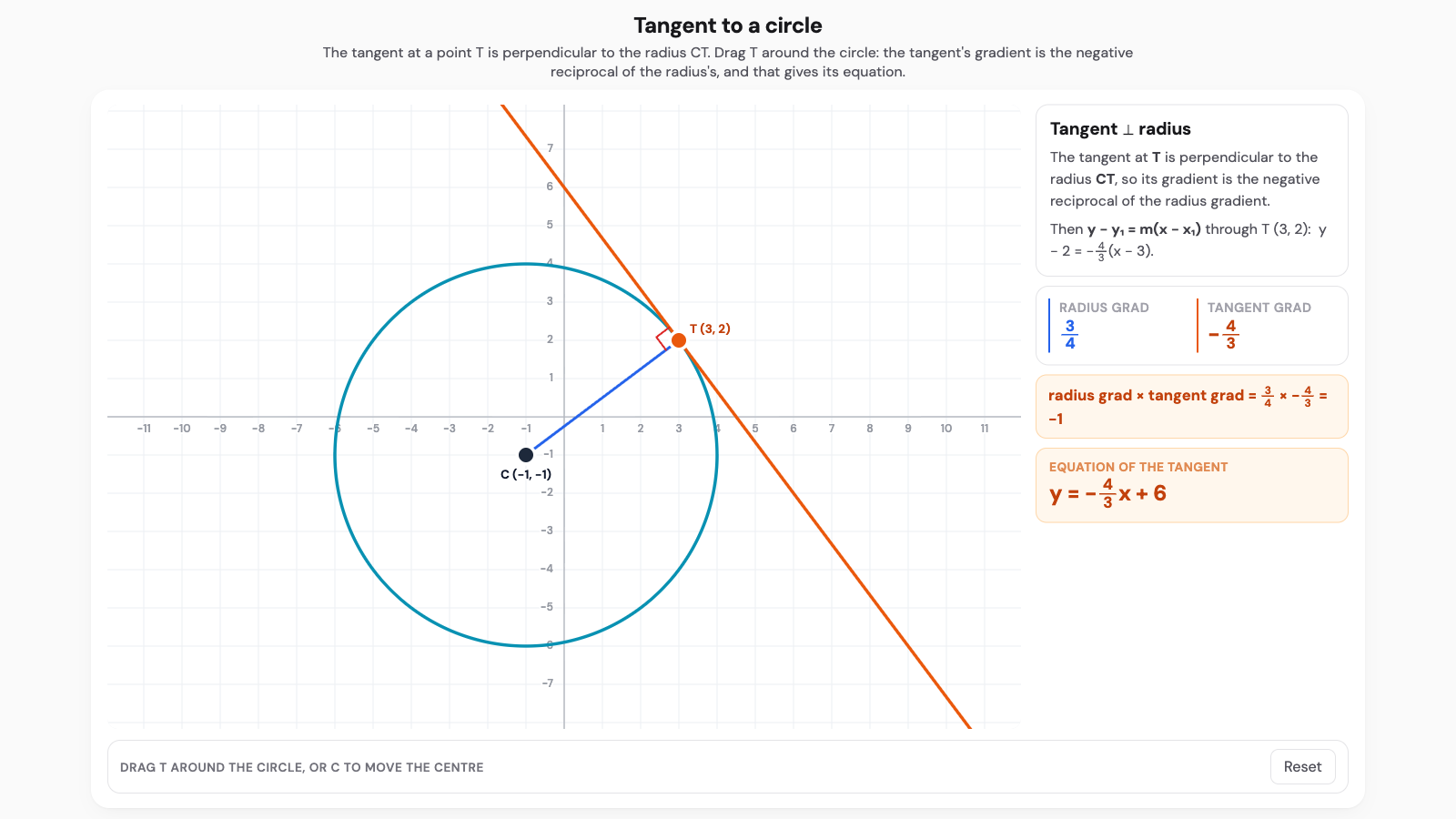
Tangent to a circle interactive. A circle with a radius to a point on it and the tangent line at that point drawn perpendicular to the radius.

Tangent to a Circle

Sec 3 · A Math Ch 7 · Coordinate Geometry

Drag the point of contact around the circle; the tangent stays perpendicular to the radius, and its negative-reciprocal gradient gives the tangent's equation.

Open interactive
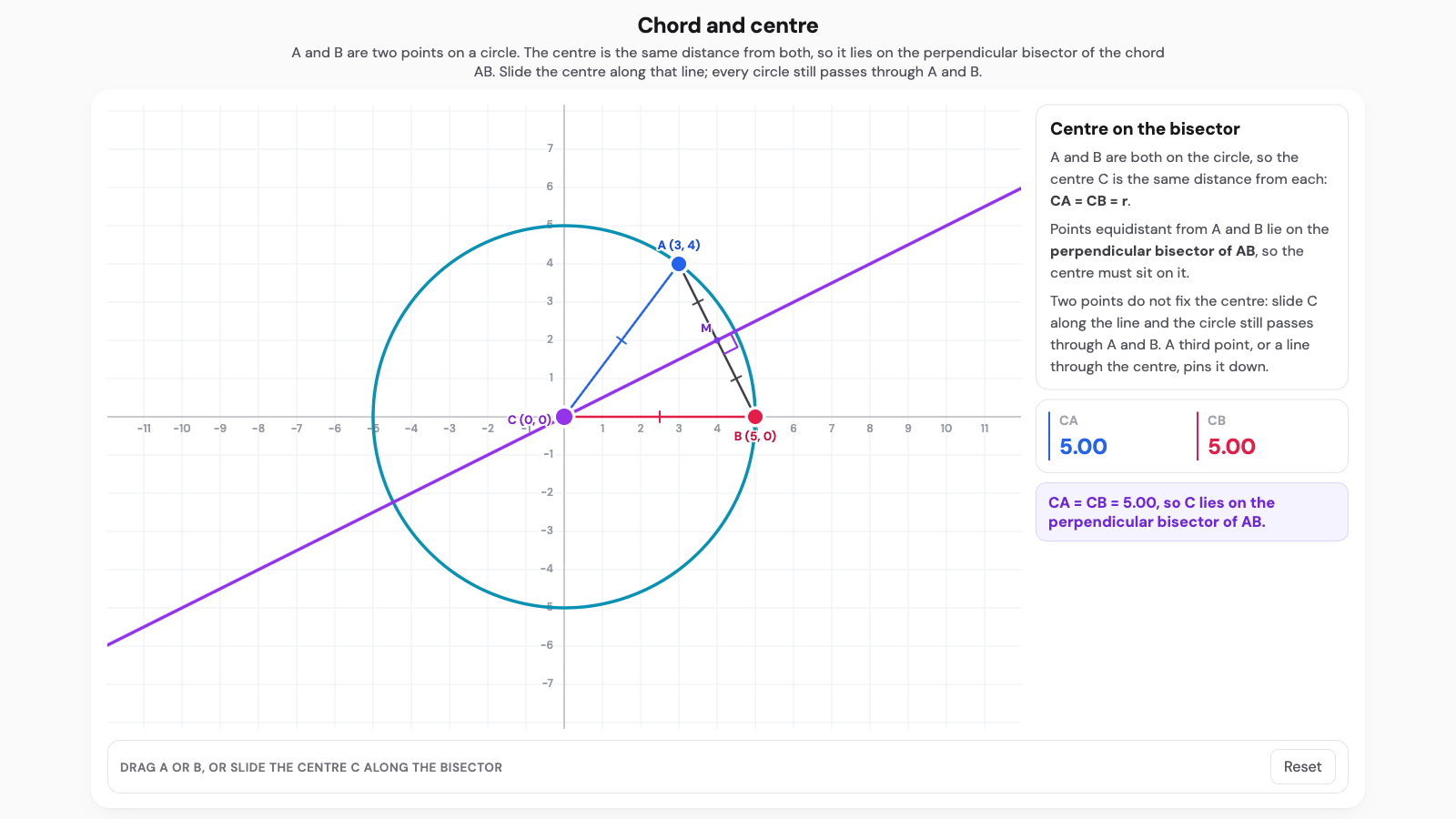
Chord and centre interactive. A circle through two points with the perpendicular bisector of the chord passing through the centre, and equal radii to both points.

Chord and Centre

Sec 3 · A Math Ch 7 · Coordinate Geometry

Two points on a circle share a perpendicular bisector that runs through the centre. Slide the centre along it to see that two points alone don't fix a circle.

Open interactive
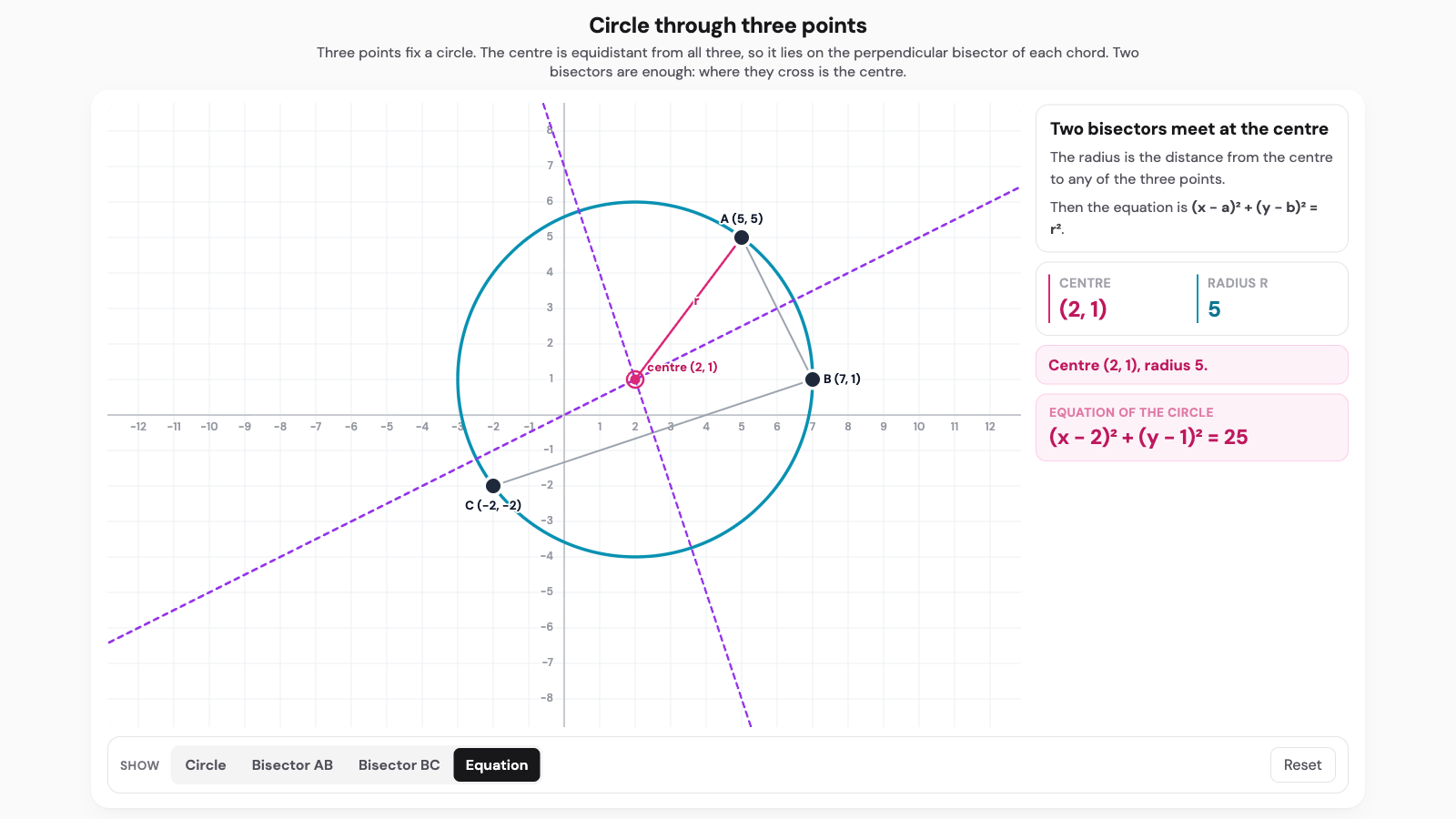
Circle through three points interactive. Three points on a circle with the perpendicular bisectors of two chords crossing at the centre, and the circle's equation.

Circle Through Three Points

Sec 3 · A Math Ch 7 · Coordinate Geometry

Three points fix a circle. Step through the perpendicular bisectors of two chords; where they cross is the centre, and the radius gives the equation.

Open interactive
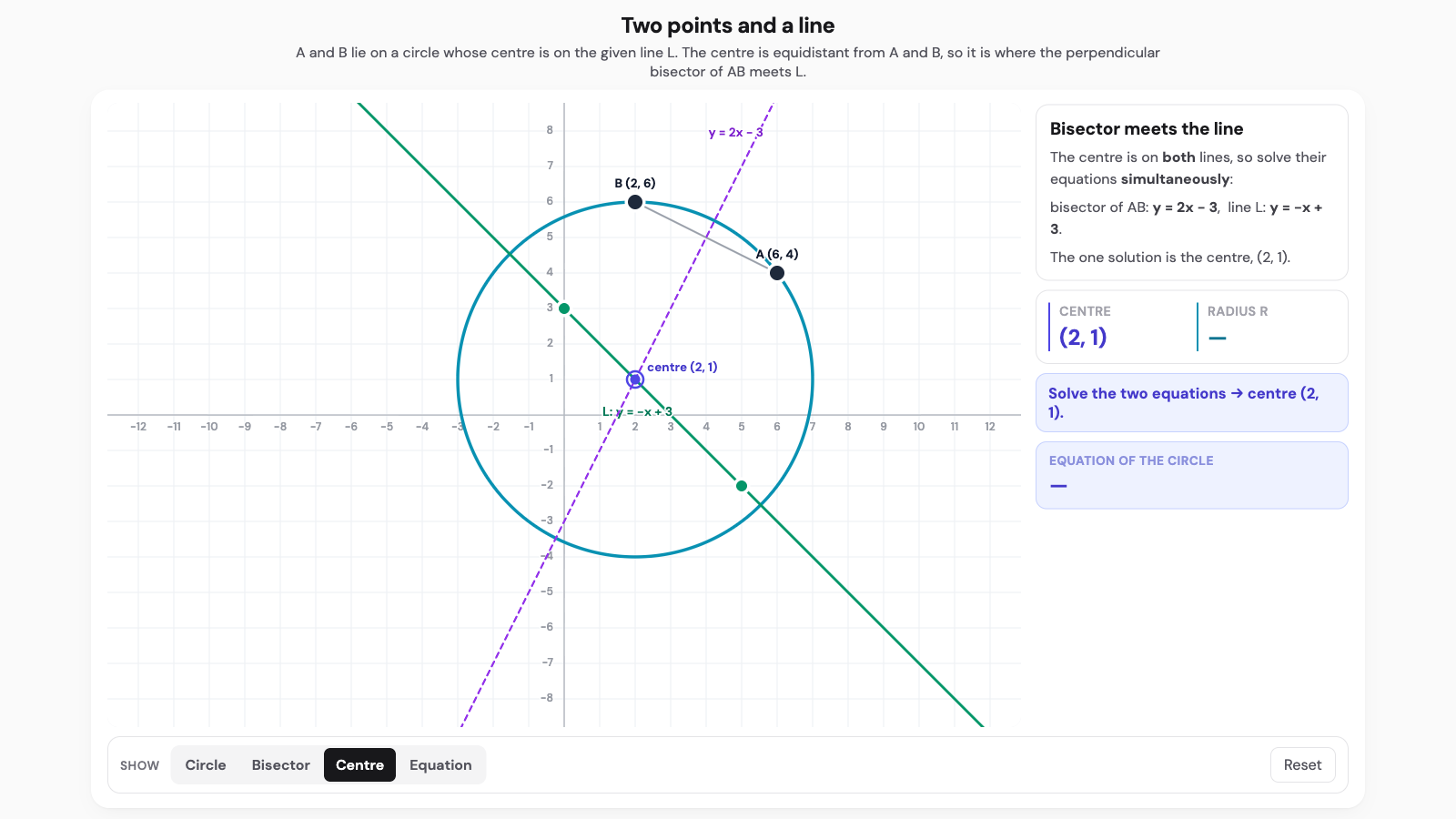
Two points and a line interactive. A circle through two points with a given line through its centre; the perpendicular bisector of the chord meets the line at the centre.

Two Points and a Line

Sec 3 · A Math Ch 7 · Coordinate Geometry

A circle through two points, with its centre on a given line. Solve the perpendicular bisector of the chord and the line together to find the centre, then the equation.

Open interactive
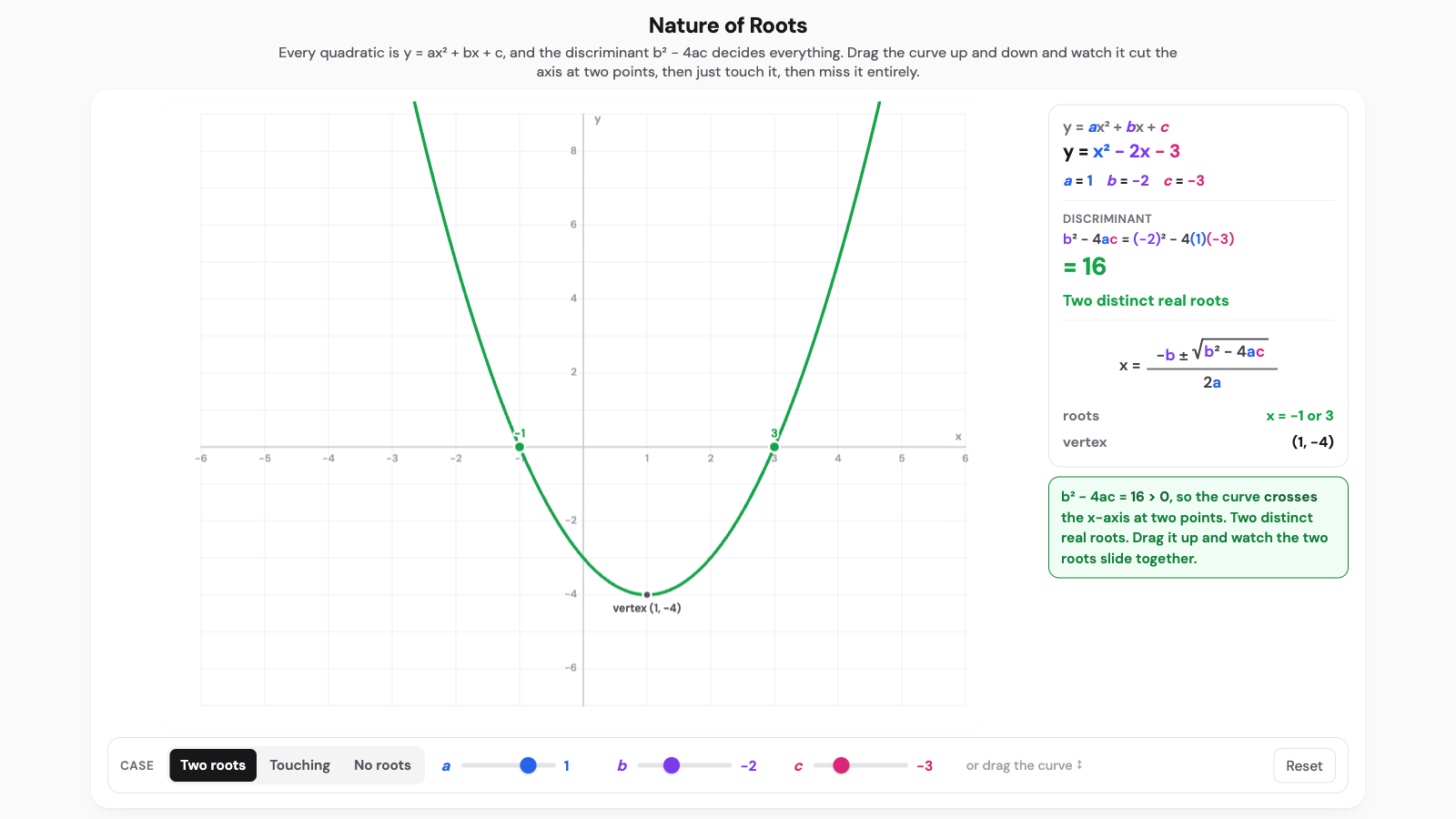
Nature of Roots interactive. A parabola on axes cutting the x-axis at two points, with the discriminant b² − 4ac worked out beside it.

Nature of Roots

Sec 3 · A Math Ch 2 · Equations and Inequalities

Drag a parabola up and down and watch b² − 4ac decide it: cutting the x-axis twice, just touching, then missing it entirely.

Open interactive
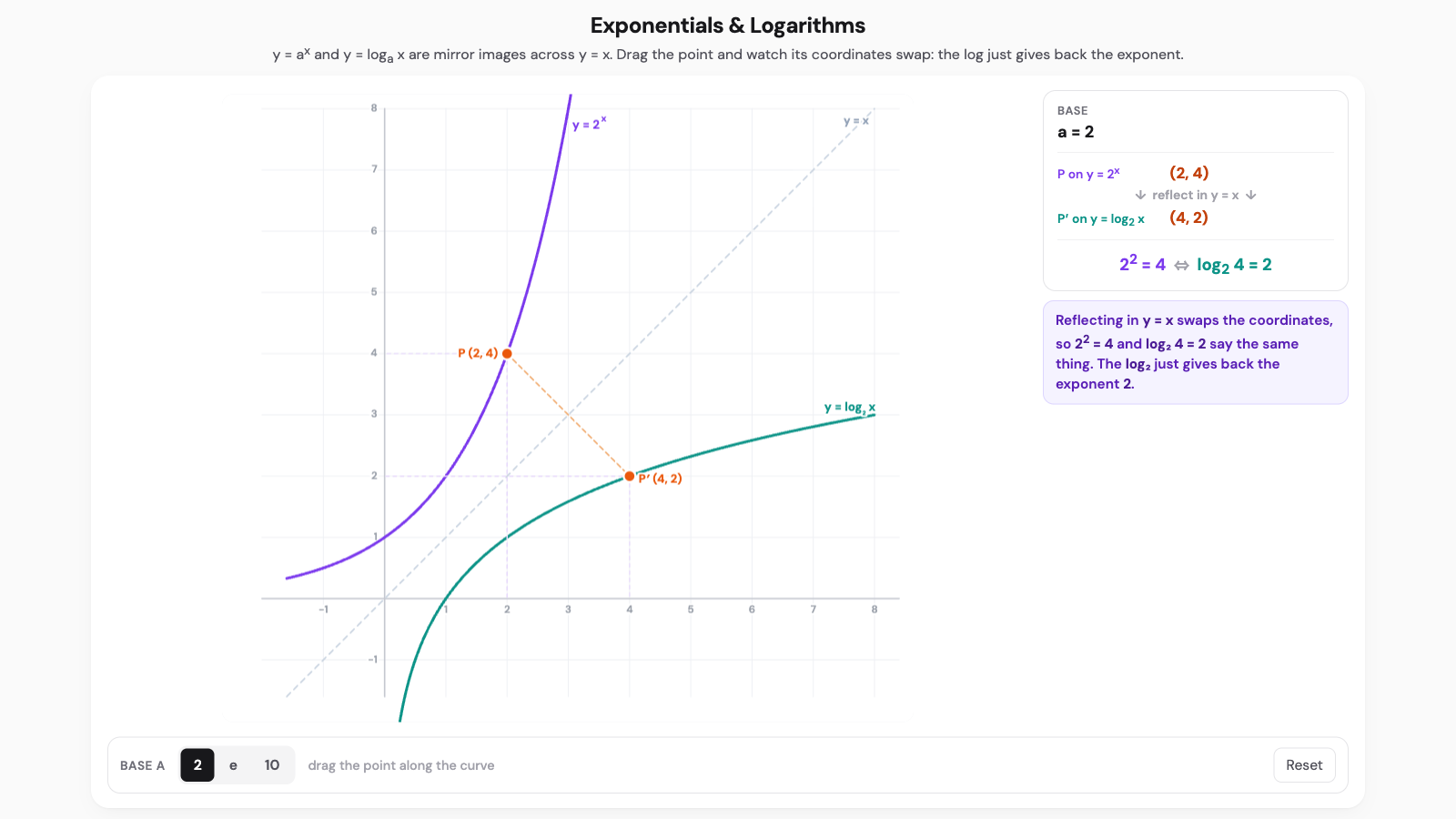
Exponentials and Logarithms interactive. The curves y = a^x and y = log_a x reflected across the line y = x, with a point and its mirror image.

Exponentials & Logarithms

Sec 3 · A Math Ch 6 · Exponential & Logarithmic Functions

Drag a point on y = aˣ and watch its mirror image land on y = logₐ x: a log is just the inverse of an exponential.

Open interactive
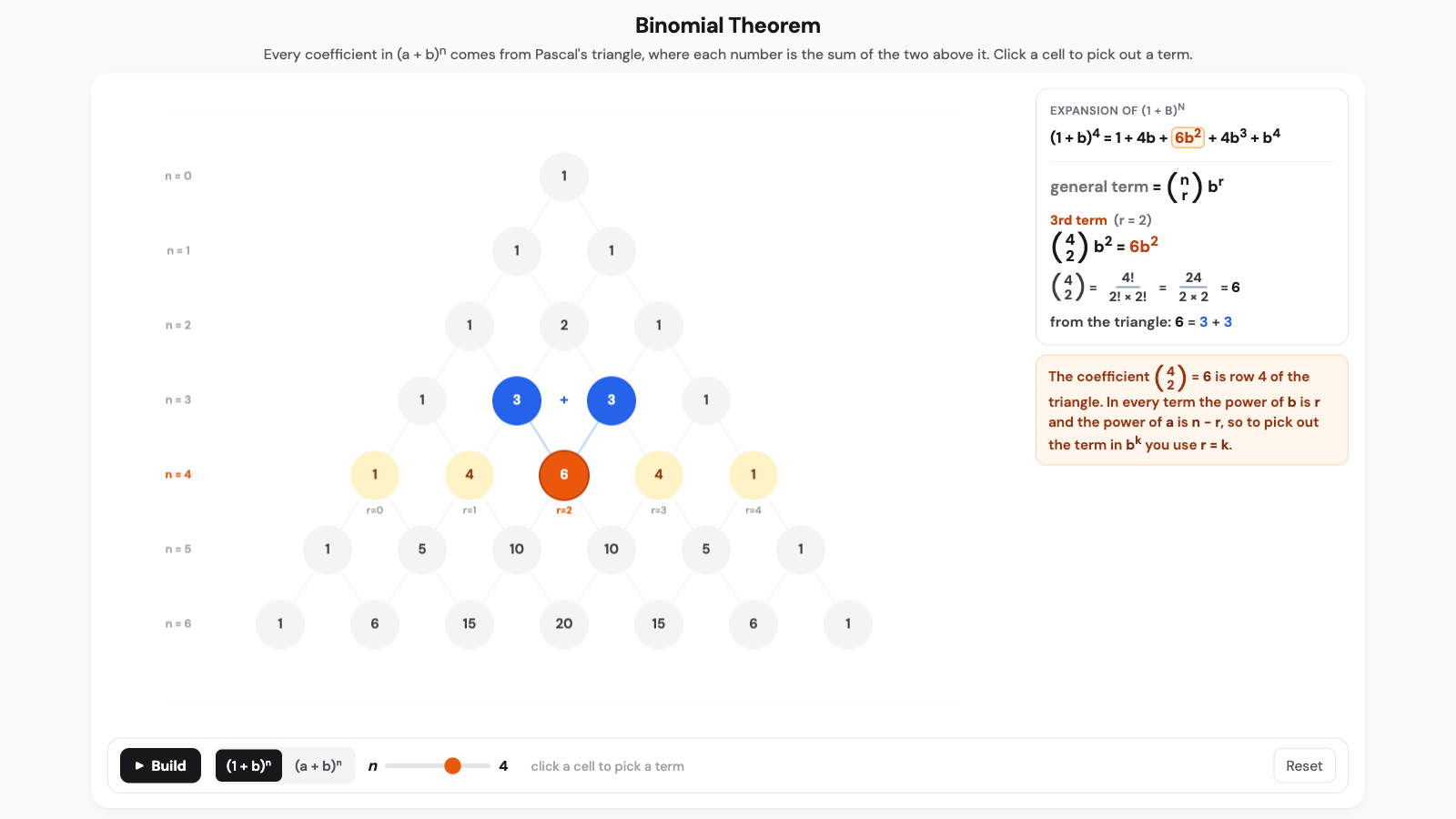
Binomial Theorem interactive. Pascal's triangle with a selected cell and its two parent cells highlighted, feeding the coefficients of the binomial expansion.

Binomial Theorem

Sec 3 · A Math Ch 5 · Binomial Theorem

Watch Pascal's triangle build from the sum of pairs, and click a cell to see where each term of the expansion comes from.

Open interactive
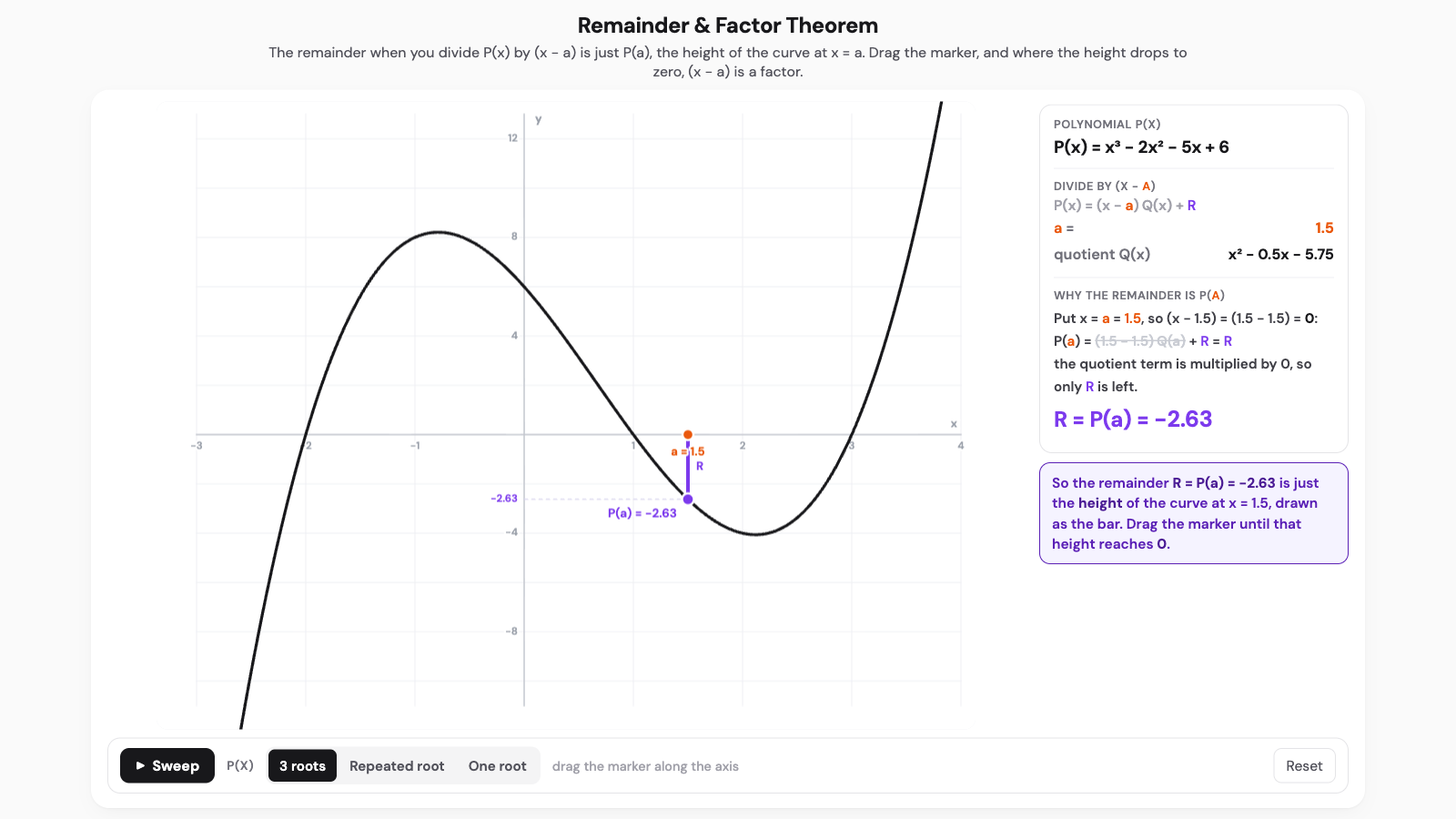
Remainder and Factor Theorem interactive. A cubic curve with a marker on the x-axis and a vertical bar up to the curve showing the remainder as a height.

Remainder & Factor Theorem

Sec 3 · A Math Ch 4 · Polynomials

The remainder when you divide by (x − a) is just P(a), the height of the curve. Drag the marker until the height hits zero to find a factor.

Open interactive
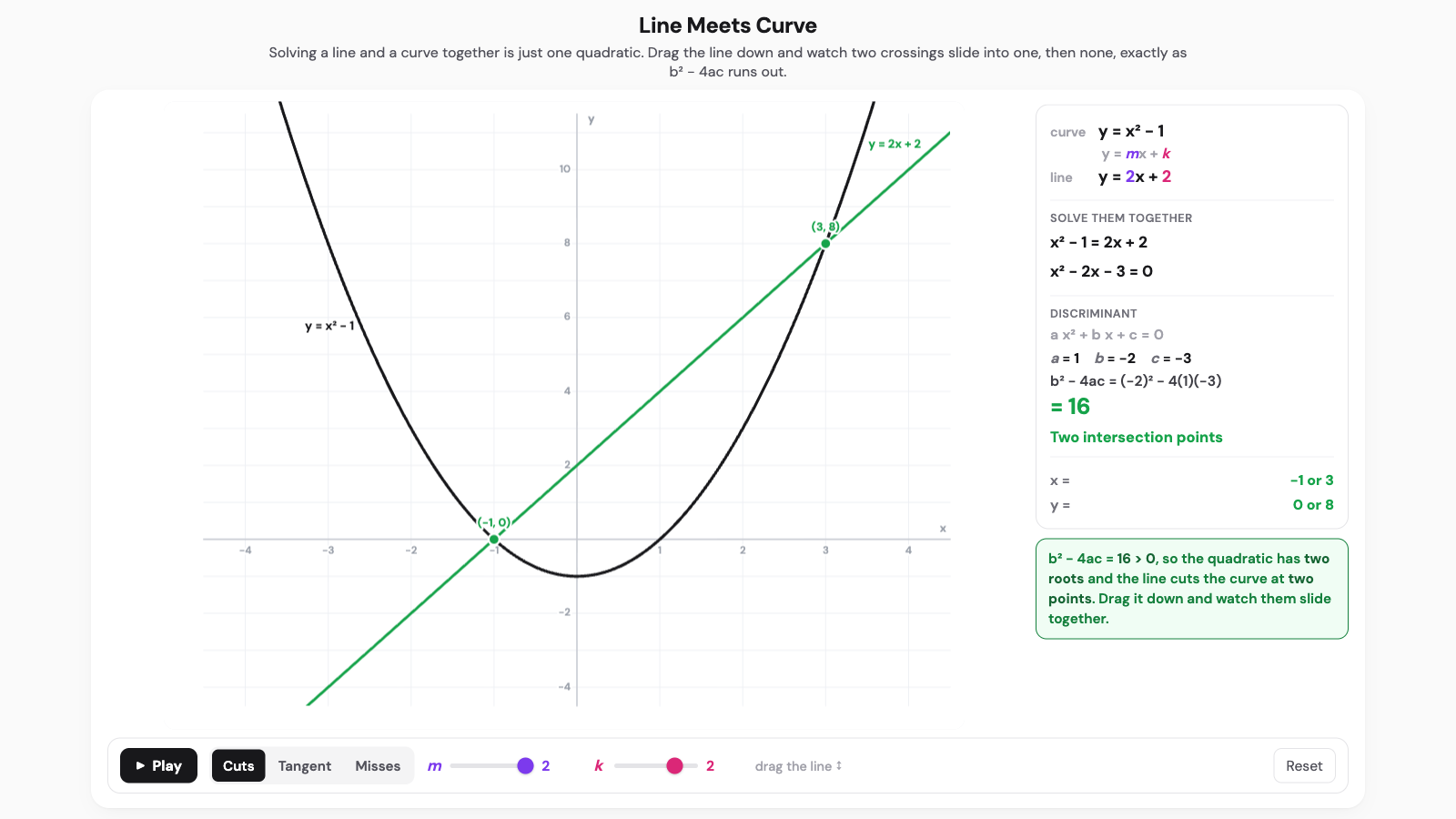
Line Meets Curve interactive. A straight line crossing a parabola at two marked points, with the substituted quadratic worked out beside it.

Line Meets Curve

Sec 3 · A Math Ch 2 · Equations and Inequalities

Drag a line across a curve. Two crossings slide into one, then none, exactly as the substituted quadratic runs out of roots.

Open interactive
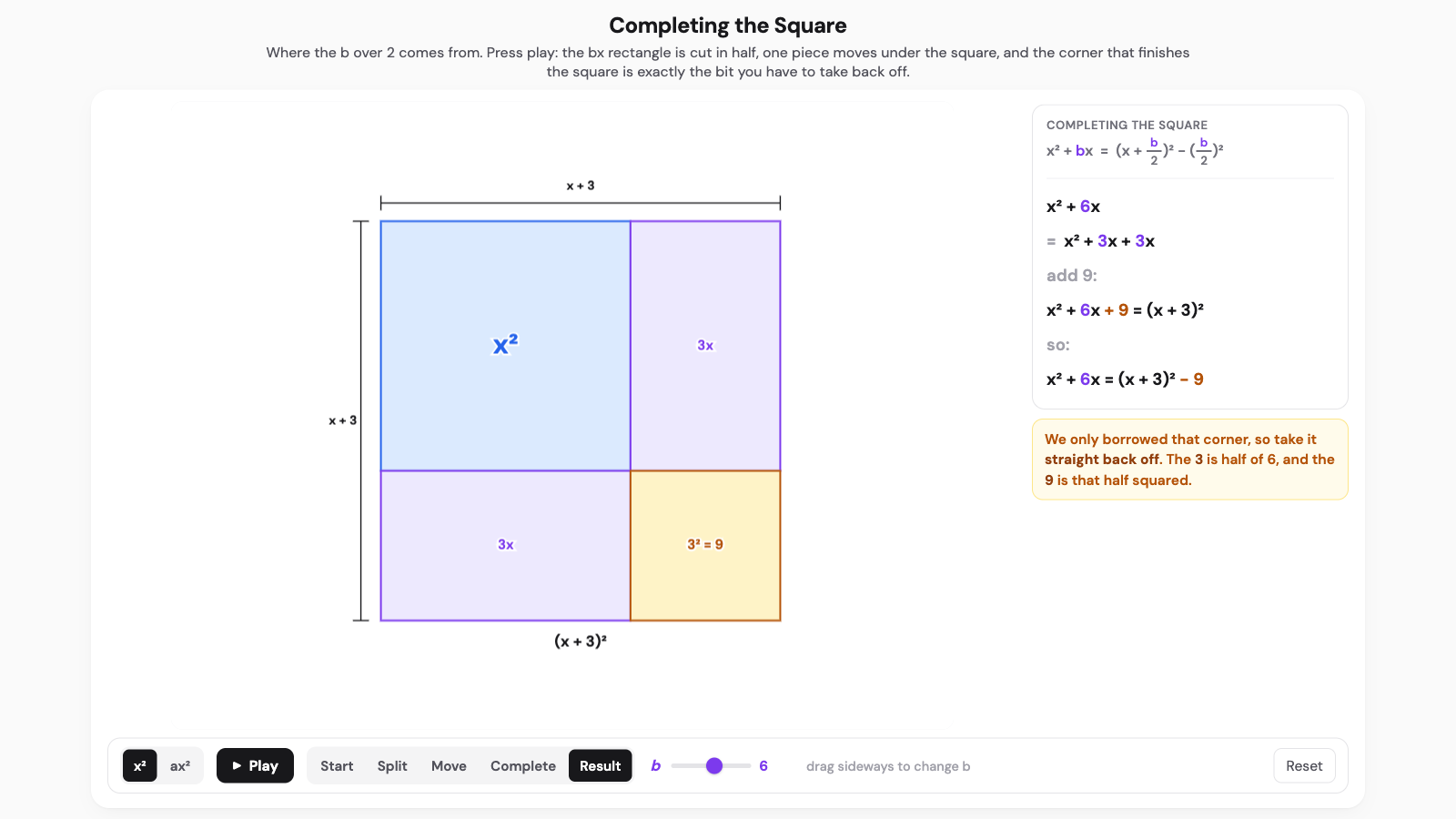
Completing the Square interactive. An x squared tile with two half-strips moved around it, and the corner tile that finishes the square.

Completing the Square

Sec 3 · A Math Ch 1 · Quadratic Functions

Cut the bx rectangle in half, slide one piece under the square, and the corner that finishes it is exactly what you take back off.

Open interactive